
Water Repellent Finishing and Fabric Handfeel Tradeoffs: The Swatch That Feels Right and Sheds Nothing
A soft handfeel is often read as proof that a water repellent finish was applied lightly and well. That reading holds only in a narrow case. This note works through the variables that actually decide the tradeoff, uses verified rolls as boundary cases, and closes with a conditional rule.

PRODUCTS
Products in this report
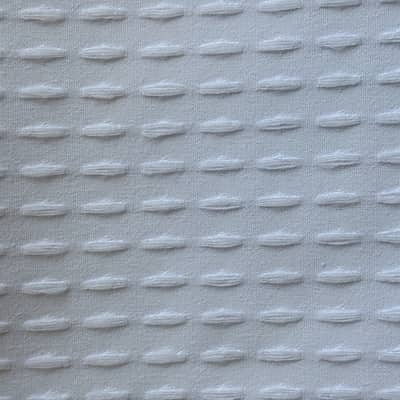
Raised Dash Jacquard Fabric
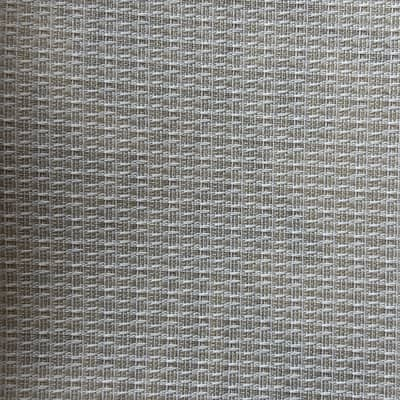
Crosshatch Linen-Look Fabric
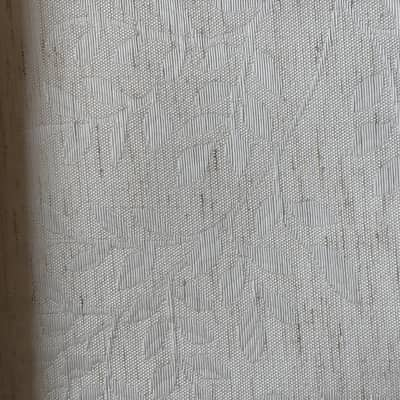
55 Large Floral Jacquard Fabric
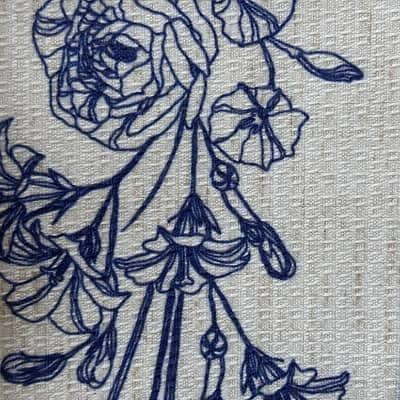
27-001-F Navy Floral Polyester-Linen Fabric
The Soft Swatch That Proves Less Than It Seems
A buyer runs a palm across a shower curtain base, feels a dry, slightly powdery softness, and files it as well finished. The logic feels sound: a harsh, waxy or stiff surface is what a heavy repellent treatment is supposed to leave behind, so a soft surface must mean the finish was applied with restraint. In one narrow situation that inference holds — when the roll is a plain, light, non-directional ground bought for a decorative outer curtain that never meets direct spray, and the only performance question is whether the cloth feels pleasant in the hand.
It fails the moment the same roll has to shed water in a wet zone. Handfeel is a surface impression measured at the fingertips; water repellency is a behaviour measured where liquid meets cloth and stays or leaves. A finish can be present and soft, present and stiff, or barely present and still soft because the base itself was always smooth. The swatch in your hand cannot separate those three cases. That is the whole problem behind water repellent finishing and fabric handfeel tradeoffs: the two properties are judged by different senses, at different moments, and one is routinely used as a proxy for the other.
Where the Two Properties Actually Part Company
Repellent finishing works at the fibre surface, altering how water interacts with the yarn rather than sealing the cloth. Handfeel is the summed impression of fibre, yarn, construction and whatever the finishing pass left on the surface. Because both are surface phenomena, buyers assume they move together and in opposite directions: more repellency, less softness. Often they do, but the relationship is not fixed, and three variables bend it.
The first is construction. A raised or jacquard structure presents more surface area and more shadow to the hand, so the same finishing route reads differently on a 185 GSM raised dash than on a flat 155 GSM crosshatch. The second is the base fibre blend: a polyester-linen blend and a pure polyester ground respond differently to the same surface treatment, and the linen content contributes its own dry, slightly irregular touch. The third is what the finish is actually being asked to do — bead water briefly at the surface, or hold that behaviour through the handling a finished curtain receives. Those are not the same brief, and they do not cost the same handfeel.
None of this can be settled from a flat swatch under a sample-room lamp. It has to be settled against the presentation and the exposure the finished product will meet.
Two Rolls That Sit at Opposite Ends of the Tradeoff
27-DS001-F, a 100% polyester raised dash jacquard at 185 GSM and printable, is the case where structure and weight already give the hand something to read. A repellent pass on a surface this textured tends to register as a slight crispness along the raised cells rather than a uniform change across the face, so the handfeel cost is localised and often acceptable where the cloth is meant to look deliberate in a hard-lit bathroom.
27-001-E, a 100% polyester crosshatch linen-look at 155 GSM and printable, sits at the other end. Its whole commercial argument is a quiet, dry, natural touch, and that is precisely the impression a heavier surface treatment is most likely to flatten. A buyer who approves this roll on handfeel alone and then asks for stronger repellency is asking the same cloth to do two jobs that pull against each other.
These are boundary cases, not endorsements. The point is that the tradeoff is not uniform across a range: on a structured, heavier base the handfeel cost may be tolerable, while on a light linen-look base the handfeel is the product.
The Buyer Scenarios That Change Which Side Wins
A hotel bathroom programme usually puts the curtain in the spray zone, where the cloth meets water repeatedly and the housekeeping team notices a curtain that clings or wets through. Here the finish is doing service work, and a small loss of softness is a fair price — provided the finished panel has been assessed wet, not just felt dry.
A retail or private-label range is judged on the hanging and folded impression first. The customer meets the surface through a photograph and a touch in store, and a repellent finish that stiffens the drape or dulls the linen-look touch can cost more at the shelf than it saves in the bathroom. A decorative outer curtain hung clear of direct spray belongs here: the finish may be light or absent, and handfeel carries the decision.
A contract buyer specifying across both end uses has the hardest brief, because one roll is being asked to satisfy a service requirement and a sensory one. That is usually the signal to stop looking for a single compromise roll and to split the specification.
What a Wet Test Shows That a Dry Hand Cannot
The useful question is not whether the swatch feels soft, but whether the shortlisted roll still behaves as intended when water reaches it in the presentation the finished curtain will occupy. Ask for a panel from the exact roll, hung or gathered at the width the curtain will be pulled to, and assessed for how water sits and leaves the surface — then felt again once dry, because some finishes read differently after wetting.
Ask, too, for the handfeel judgement to be made on the same panel rather than on a separate flat cutting, since a structured base can feel crisp flat and soft gathered. Where a print is expected later in the programme, confirm print status on that exact SKU, because a base that sheds water well and cannot carry the next colourway will force a re-specification. This is the kind of question the curtains.vip team, working as Shaoxing Haowen Textile Clothing Co., Ltd. (the company behind the curtains.vip team), can answer against a specific roll rather than in general terms; the product pages at /products list the construction facts per SKU, and /contact is the route for a sample request.
Where the Range Usually Needs Two Rolls, Not One
Most programmes that argue about this tradeoff are really trying to make one base do both jobs. The cleaner structure is usually two: a structured, heavier printable base for the wet-zone curtain where repellency earns its place, and a lighter linen-look base for the decorative or retail-facing position where the touch is the product. 55#, a 95% polyester / 5% linen large floral jacquard at 165 GSM and printable, and 27-001-F-PRINT, a 92% polyester / 8% linen printed floral at 150 GSM, show how a range can carry structure and print without asking either roll to be everything.
55 Large Floral Jacquard Fabric
27-001-F Navy Floral Polyester-Linen Fabric
Splitting the range has a commercial consequence worth naming once: each SKU carries its own minimum, and the usual reference MOQ is 2,000 m per SKU, with orders below that accepted at a slightly higher unit price. A pilot quantity is therefore a legitimate way to test a finish on one property or one retail door before committing the full range. The usual reference MOQ is 2,000 m per SKU; orders below 2,000 m are also accepted, with a slightly higher unit price.
The Conditional Answer
Choose the stronger repellent finish, and accept the handfeel cost, when the curtain sits in the spray zone, the property launders or handles it in service, the base is structured enough that the crispness reads as deliberate, and the finished panel has been assessed wet in its hanging presentation. Under those conditions performance is the brief and softness is a secondary impression.
Choose the softer, lighter finish — or none — when the curtain is decorative, hung clear of direct spray, judged on the shelf or at the fold, and the linen-look touch is the reason the roll was shortlisted. Under those conditions the handfeel is the product, and a finish that dulls it is a cost with no matching benefit. If your brief genuinely spans both, stop negotiating with one roll and specify two.
Questions buyers ask
Does a soft handfeel mean the water repellent finish is weak?
Not necessarily. Softness and repellency are separate surface properties, and a smooth base can feel soft with little finish present. The only reliable check is a wet assessment on a panel from the exact roll in its hanging presentation, followed by a handfeel judgement on that same panel.
Can a structured jacquard take a repellent finish without losing its character?
It can be more forgiving than a light linen-look base, because the raised structure already gives the hand something to read and the finish tends to register along the cells rather than across the whole face. That is a general expectation, not a guarantee for any specific SKU; it has to be confirmed on the roll you shortlist.
Should one roll serve both a wet-zone and a decorative curtain position?
Usually not. When the brief spans a service requirement and a sensory one, splitting into a structured printable base for the wet zone and a lighter linen-look base for the decorative position avoids a compromise that satisfies neither. Each SKU then carries its own minimum.