
Fabric Surface Direction for Hospitality Interiors: The Reorder Failure Nobody Catches at Approval
Surface direction is decided by how a roll is cut and fed, not by the swatch a hotel project approves. This failure analysis follows a reorder that arrives with the grain running the other way, and sets out the checks that prevent it.

PRODUCTS
Products in this report
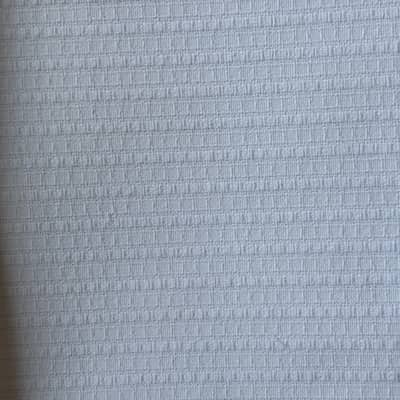
Fine Textured Jacquard Fabric
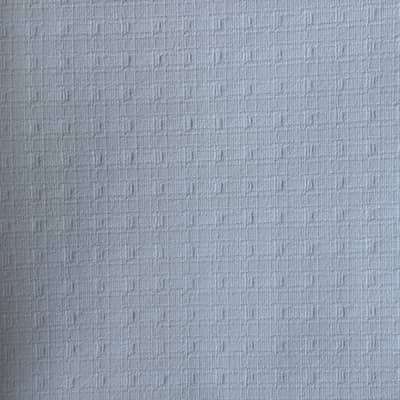
Fine Grid Jacquard Fabric
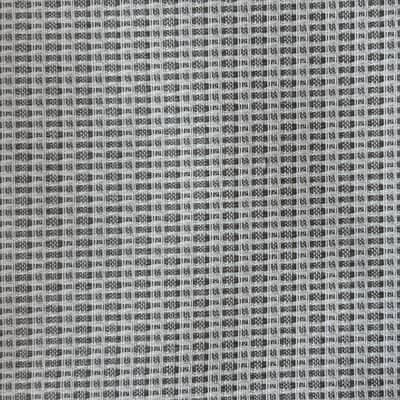
Vertical-Stripe Polyester-Cotton Linen-Look Fabric
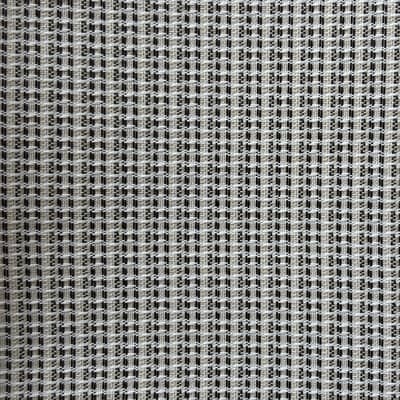
Contrast Grid Linen-Look Fabric
The Reorder That Arrives Sideways
The approval sample looked right. The bulk order looked right. The trouble appeared at the second order, when a hotel corridor's replacement curtains were cut from a new roll and hung beside the originals. Under the corridor downlights, the new panels read a shade lighter than the old ones, and the vertical texture that had run cleanly down the first set now seemed to lean. Nothing in the specification had changed. The roll had simply been cut on the other axis.
This is the quiet failure mode in fabric surface direction for hospitality interiors. Direction is not a colour, a weight or a composition. It is a property of how a woven or textured surface is oriented relative to the panel, and it can be reversed without any number on the spec sheet moving. Buyers who treat surface direction as an aesthetic preference rather than a production instruction tend to discover it at installation, in front of a guest, on a roll they have already paid for.
Why Direction Drifts Between Orders
A roll has a length and a width, and a panel can be cut from either. When a fabric carries a visible directional structure — a slub, a stripe, a jacquard grid, a brushed or raised face — the way light falls across that structure changes depending on which way the panel is turned. Two panels cut from the same roll, one rotated ninety degrees against the other, can read as two different fabrics in a lit room.
The drift usually enters through one of three doors. First, a cutting plan optimised for yield: a marker that rotates a piece to save metres will reverse the surface direction of that piece. Second, a change of base between orders, where a supplier substitutes a visually similar construction whose directional structure runs differently. Third, a finishing or feeding change at the mill, where the same article is run through the line in a different orientation and the surface takes on a slightly different sheen.
None of these is necessarily a defect. Each is a handoff where an unstated assumption about direction can be lost. The buyer's protection is not to demand a particular direction, but to state which direction the finished panel must present and to require that it be checked before cutting.
Detecting Direction Before It Becomes a Complaint
Direction is easier to see than to measure, which is exactly why it slips through numerical specifications. The practical tests are visual and comparative, and they belong in the sample room rather than on the spec sheet alone.
Lay two panels of the same fabric side by side, one rotated against the other, and view them under the light the installation will actually use. In a hotel corridor that is usually a warm downlight at an angle; in a guestroom it may be daylight from a window. If the two panels read differently, the fabric is directional and the cutting orientation has to be fixed.
Then check the roll itself. Ask for the surface direction to be marked at the roll end, and confirm that the marker you receive carries the same orientation. A one-metre sample cut from the middle of a roll tells you what the surface looks like; it does not tell you which way it was fed. That distinction is the whole point.
- View rotated panels under the project's actual lighting, not showroom light.
- Confirm whether the roll is marked for surface direction at the end.
- Check that the cutting marker preserves the orientation of the approved sample.
- Compare the new roll against a retained panel from the previous order, not against a photograph.
Two Rolls That Look Alike and Decide Differently
The reason direction is easy to miss is that two superficially similar fabrics can carry completely different directional behaviour. Consider two verified options from the curtains.vip range. The 27-DS001-D Fine Textured Jacquard Fabric is a 100% polyester jacquard at 180 GSM, printable, with a fine texture. The 27-DS001-H Fine Grid Jacquard Fabric is also 100% polyester, also printable, but at 190 GSM with a fine grid structure. Both are white, both are jacquards, and both sit in a similar weight band.
Fine Textured Jacquard Fabric
Fine Grid Jacquard Fabric
The grid structure of the second roll gives the surface a more regular directional read than the fine texture of the first. In a corridor where panels are butted together, that regularity makes any orientation mismatch more visible, because the eye can follow the grid from one panel to the next. The fine texture is more forgiving of a small rotation. Neither roll is better; they simply fail differently, and the buyer who knows which one they are specifying can write the right cutting instruction.
A second comparison sharpens the point. The 27-001-B Vertical-Stripe Polyester-Cotton Linen-Look Fabric is a 94% polyester, 6% cotton blend at 160 GSM, printable, and its stripe is inherently directional — a vertical stripe rotated becomes a horizontal one, which is not a subtle shift but a different design. The 27-001-C-1 Contrast Grid Linen-Look Fabric is 100% polyester at 155 GSM and is not printable, with a contrast grid that reads as a surface rather than a line. For a project that will be reordered, the stripe demands an explicit orientation instruction in a way the grid may not.
What Belongs in the Specification
Surface direction should be written as a production requirement, not a note. The specification needs to name the approved SKU, state the required orientation of the finished panel, and require that the cutting marker and the roll-end marking both preserve it. It should also require a retained reference panel from the approved order, kept by the buyer, so that the next delivery can be compared against a physical standard rather than a memory.
Where a project will run across multiple phases, the specification should state that the surface direction is part of the approved article and that any substitution must be re-approved against the retained panel. This is the clause that catches the third failure door — a silent base change — before it reaches a guestroom.
The commercial terms sit alongside this, not in place of it. The usual reference MOQ is 2,000 m per SKU, and orders below that are accepted with a slightly higher unit price, which allows a single corridor or a pilot floor to be cut and hung before a group-wide commitment. That pilot is the cheapest place to discover a direction problem. The usual reference MOQ is 2,000 m per SKU; orders below 2,000 m are also accepted, with a slightly higher unit price.
The Checks That Prevent the Opening Mistake
Three checks do most of the work. First, before approval, view two rotated panels of the shortlisted fabric under the project's real lighting and record whether the surface is directional. Second, before cutting, confirm that the marker and the roll-end marking agree with the approved orientation. Third, before the next order ships, compare a panel from the new roll against the retained reference panel, side by side, in the same light.
If a project needs a base that behaves predictably across reorders, the curtains.vip range can be reviewed at /products, and specific direction questions can be put to the team through /contact. Shaoxing Haowen Textile Clothing Co., Ltd. (the company behind the curtains.vip team) develops curtain, shower-curtain and table-linen fabrics, including custom print development and finished shower curtain OEM/ODM, and can confirm the construction details that determine how a surface is oriented. The point is not to eliminate direction as a variable, but to decide it deliberately rather than discover it in a corridor.
Questions buyers ask
Is surface direction the same as fabric grain?
They overlap but are not identical. Grain usually refers to the direction of the warp and weft in a woven cloth. Surface direction is the broader property of how a textured, striped, brushed or jacquard face reads when the panel is rotated. A fabric can have a straight grain and still show a visible directional surface.
Can surface direction be measured numerically?
Not reliably in a way that replaces a visual check. It is best confirmed by viewing two rotated panels of the same roll under the lighting the installation will use, and by requiring the roll end and the cutting marker to preserve the approved orientation.
Does a printable fabric always behave the same way after printing?
No. Print compatibility is product-specific, and printing can change how a surface reads. A base that is printable may still need its surface direction fixed in the specification, and the printed result should be checked against the approved panel rather than assumed.