
What a Catalogue Can and Cannot Tell a Shower-Curtain Buyer
One search row reached curtains.vip asking what a supplier's products are. That is a small signal, but it points at a real buyer problem: a catalogue lists rolls, while a buyer needs to know what each roll can do. This note separates the observed signal from the inference and sets out what to test next.

PRODUCTS
Products in this report
The Question Behind a Catalogue Visit
A buyer who lands on a fabric catalogue looking for what a supplier actually makes is usually not browsing. They are trying to work out whether the range can answer a brief they already hold: a shower-curtain programme, a hotel replacement, a private-label colourway. The catalogue answers with rolls. The brief asks what those rolls can do once they are cut, gathered, printed and reordered.
That gap is the subject of this note. It is not a guide to any single fabric, and it is not a claim about where the shower-curtain market is heading. It is an attempt to separate what one small first-party signal shows from what a buyer can reasonably infer, and to name the uncertainty honestly.
One Search Row, Read Carefully
In the last 28 days, a single search for the phrase "what is their products" reached curtains.vip, recorded as one impression and one click, with the landing page being the site root. That is the entire measured signal. It is a curtains.vip observation, not a market measurement, and it does not establish demand, market size, share or direction for shower-curtain fabric anywhere.
What it does suggest, cautiously, is a category of buyer behaviour: someone arriving without a SKU in mind, trying to understand the shape of a range before narrowing it. That reading is inference, not evidence. A single row cannot carry a trend claim, and we do not treat it as one. It is worth noting only because it matches a pattern that appears in buyer conversations more often than in search data.
Why a Roll List Is Not an Assortment Answer
Catalogues are organised by product. Buying decisions are organised by constraint. A shower-curtain programme usually has three constraints running at once: the surface has to read correctly in the position it will occupy, the base has to accept whatever comes next, and the specification has to repeat on the next order.
A roll list can describe the first constraint and part of the second. It rarely describes the third, because repeatability is a property of the production relationship rather than the product page. This is where a buyer's inference has to stop and a question has to be asked. Weight, composition and print status are listed facts. Whether the same roll will arrive at the same specification in eight months is a commitment, not a catalogue field.
Where Print Status Changes the Shape of a Range
The most consequential field in a shower-curtain catalogue is often the least dramatic: whether a base is printable. Two rolls can share a weight band, a linen-look surface and a near-identical tone, and still belong to different commercial lives. One can absorb a seasonal print, a private-label colourway or a logo programme. The other has to earn its place on surface and hand alone.
This is not a quality distinction. A non-printable base is not a lesser roll; it is a roll with a narrower future. The practical consequence is concentration risk. A range built on a single printable base has one point of failure for every future artwork decision. A range with two printable bases that have each been tested with an actual motif has somewhere to move when the first choice is unavailable or unsuitable.
Two Verified Rolls as an Illustration
The contrast is easier to hold with real SKUs. 27-001-C-1 is a 155 GSM 100% polyester contrast-grid linen-look fabric, and it is listed as not printable. 27-008-3 is a 130 GSM 92% polyester / 8% linen woven-stripe fabric, and it is listed as printable. Both are plausible shower-curtain bases. They simply do not carry the same optionality.
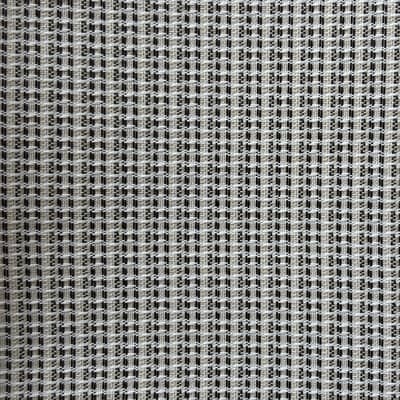
Contrast Grid Linen-Look Fabric

Polyester-Linen Stripe Fabric
A buyer assembling a range that may later need a print, a colourway or a brand motif would be making a different decision with each. That is the whole point of reading print status before reading price. It is also where the catalogue stops being sufficient: neither listing tells you how either base behaves when gathered on a rail, and that is the test that decides whether the surface reads as intended.
What the Signal Does Not Support
It would be easy to inflate one search row into a story about buyers moving away from specification-led sourcing. There is no basis for that. The row describes a search that reached our site; it says nothing about how buyers behave elsewhere, and nothing about volume, growth or share.
The honest position is narrower. Some buyers arrive without a specification and try to build one from the catalogue. Others arrive with a specification and use the catalogue to check it. Both are normal, and neither is a trend. What matters editorially is not to dress a single observation as market research, and not to let it stand in for evidence we do not have.
Three Things to Test Next
First, check whether the range names more than one printable base, and whether each has been tested with the motif the programme actually intends to run rather than a generic swatch. If the answer is one base, the concentration risk is worth pricing before the artwork is approved.
Second, ask for the shortlisted base to be shown gathered on a rail at the width the finished curtain will actually be pulled to, under the lighting of the room it is bought for, with a reference panel retained from that same roll. A flat swatch cannot answer the presentation question, and the presentation question is the one a guest or a shopper actually sees.
Third, confirm that the specification can be repeated. Shaoxing Haowen Textile Clothing Co., Ltd. (the company behind the curtains.vip team) develops curtain, shower-curtain and table-linen fabrics, including custom print development and finished shower curtain OEM/ODM, and the usual reference MOQ is 2,000 m per SKU, with orders below that accepted at a slightly higher unit price. That structure allows a pilot on one base before a range-wide commitment. The verified range is listed at /products, and a specification question is best put directly through /contact. The usual reference MOQ is 2,000 m per SKU; orders below 2,000 m are also accepted, with a slightly higher unit price.