
Colourfastness Testing for Printed Hospitality Textiles: The Guest Who Notices First Is Usually Housekeeping
Colourfastness on a printed hospitality textile is rarely decided by the print file. It is decided by the base the ink enters, the cycle the cloth will actually meet and the light it will sit under. This note separates a first-party signal from wider inference, then sets out what a buyer can specify, what remains uncertain and what to test next.

PRODUCTS
Products in this report
The Question a Buyer Asks After the First Laundry Cycle, Not Before
A printed shower curtain in a serviced apartment is approved on a flat panel under a sample-room lamp. It is judged again six weeks later, in a bathroom, by a housekeeper holding a cloth that has lost the crispness of its motif at the fold lines and along the hem. Nobody in that sequence made an obvious mistake. The print file was signed, the base was shortlisted, the price was agreed. What was never settled is the question this article is about: what, exactly, was the print expected to survive, and on which base.
Colourfastness testing for printed hospitality textiles is often treated as a lab formality attached to a purchase order. In practice it is a specification decision that belongs earlier, because the answer changes with the end use. A banquet tablecloth, a guestroom drape and a shower curtain meet different light, different washing and different viewing distances, and a print that holds on one surface may read differently on another. The useful work is not choosing a test. It is naming what the cloth has to survive before the test is chosen.
What Our Own Search Rows Show, and Where They Stop
The search rows supplied for this topic show no impressions and no clicks for colourfastness testing for printed hospitality textiles over the last 28 days. That is a statement about one website, not about the market. It does not show that buyers are uninterested, that demand is falling, or that the topic is unimportant. It shows only that this phrase did not bring anyone to curtains.vip in that window.
We treat that carefully. A zero row is an absence of first-party evidence, not evidence of absence. Wider inference — that hospitality buyers care about print durability because they reorder on a replacement cycle — is reasoning about how the trade works, not a measured trend, and we do not dress it up as research. The honest position is that this article responds to a specification gap we can describe from textile principles, while the commercial size of that gap remains unmeasured here.
Why the Base Decides More Than the Ink Does
A print does not sit on a textile in the way it sits on paper. On polyester it is carried into the fibre; on a blended or structured cloth it meets yarns of different absorbency, raised cells, slubs and grid lines, and it settles unevenly across them. Two rolls can accept the same motif and hold it differently, not because the printer changed but because the ground changed.
Structure amplifies this. A raised jacquard presents some surfaces to the light and hides others in shadow, so a motif printed across it reads as broken even when the colour itself is sound. A fine grid gives the ink a more regular path. A linen-look slub interrupts it. For a buyer, the practical consequence is that colourfastness cannot be assessed on a generic swatch of the same composition. It has to be assessed on the exact base, printed at the intended scale, and judged in the presentation the finished article will occupy.
Three End Uses, Three Different Things the Print Must Survive
Hospitality textiles are not one category. A tablecloth in a restaurant meets repeated laundering, food contact and close inspection at arm's length under warm light. A shower curtain meets humidity, a bathroom's hard side lighting and a guest standing very near it. A guestroom drape meets daylight through glass, which is a slower and more cumulative exposure than either.
These exposures do not rank in a single order. A print that holds well through washing may still shift under sustained window light; a print that resists light may soften at the fold lines where abrasion concentrates. The buyer's task is to decide which exposure dominates in the specific project, and to make the test reflect that rather than a standard sequence carried over from a previous programme. Where a programme spans more than one end use, the honest approach is to name which end use sets the reference and judge the others against it, rather than to assume one result covers all three.
What Can Be Specified Now, and What Remains Uncertain
Some things a buyer can settle at the specification stage without any test result. The base can be named by SKU and construction rather than by description. The intended print scale and placement can be fixed. The care cycle the property will actually run can be written down, including whether laundering is in-house or commercial. The lighting condition the finished article will sit under can be described. Each of these narrows the question the lab is being asked.
What remains genuinely uncertain is how a given base will behave across a production run, and how much variation between lots is acceptable. A test on one printed panel is evidence about that panel. It is not proof about the next delivery, and no supplier should present it as such. The gap between an approved printed reference and the roll that arrives six months later is where most colourfastness disputes actually begin, and it is closed by retaining a reference panel and comparing against it, not by repeating a certificate.
Where a Verified Base Fits, as an Example Rather Than a Recommendation
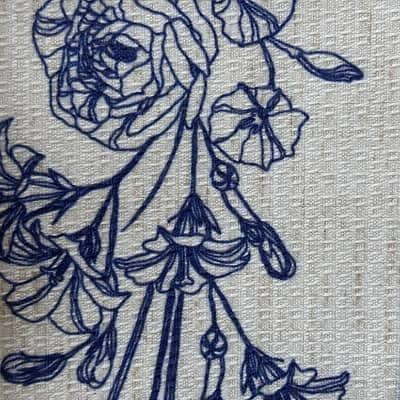
Consider 27-001-F-PRINT, a navy floral print on a 150 GSM base of 92% polyester and 8% linen, listed as printable. It is a useful illustration because the linen content and the floral motif together create exactly the condition described above: the ink meets two fibre families and a visible motif, so the printed result has more to prove than a plain ground would. Nothing here asserts how that print performs under washing or light; that is precisely the test the buyer has to commission.
The point of naming it is to show where the market question lands in practice. A buyer responding to a colourfastness concern does not necessarily change the motif. They change what they ask the supplier to demonstrate, on which base, and in which presentation. Shaoxing Haowen Textile Clothing Co., Ltd. (the company behind the curtains.vip team) develops curtain, shower-curtain and table-linen fabrics including custom print development, so a print programme can be worked against one base conversation rather than three. Buyers who want to see the range can review /products or raise a specific brief through /contact.
Two or Three Things to Test Next
First, test the print on the exact base and at the exact scale, in the presentation the article will occupy — gathered on a rail for a curtain, laid and folded for a tablecloth. A flat swatch answers a different question.
Second, write the care cycle into the brief before the sample is cut, and ask for the printed panel to be assessed against that cycle rather than a generic one. Where the property launders in-house, say so.
Third, retain a printed reference panel from the approved roll and state who will compare future deliveries against it. That single act converts colourfastness from a certificate on file into a decision the programme can actually enforce, which is the only version of it that survives the second order.
Questions buyers ask
Does a colourfastness certificate cover a printed hospitality textile across all end uses?
No. A test result describes the sample and the condition it was tested under. A tablecloth, a shower curtain and a guestroom drape meet different light, washing and abrasion, so the result has to be read against the end use it was measured for.
Should the print be tested on a generic swatch of the same composition?
It is better tested on the exact base, printed at the intended scale. Structure, slubs and blended yarns change how ink settles, so a swatch of matching composition can still mislead.