
Textured Yarn Effects in Hospitality Textiles: The Shadow You See at the Fold Is the Specification You Have Not Written
A textured yarn effect is a visual promise made at arm's length and kept or broken at the fold. This field note reads slub, dash and grid surfaces the way a guest does, then moves to what a buyer has to measure, test and price before a hospitality programme is signed.

PRODUCTS
Products in this report
The Shadow That Appears When the Cloth Turns
Fold a metre of slub cloth in half and hold it toward a window. The surface that read as an even, quiet natural tone on the table now carries a soft ridge along the crease, and the light breaks across it in small uneven patches. Nothing has been added to the cloth. The geometry of the fold has simply given the yarn somewhere to cast a shadow.
That shadow is the whole commercial argument for textured yarn effects in hospitality textiles, and it is also the reason they are so easy to buy badly. A guest does not meet a fabric flat on a sample table. They meet it gathered at a rail, creased where housekeeping folded it, and lit from one side by a bathroom downlight. The effect a buyer approved at arm's length is not the effect the room will show.
Why the Effect Is a Yarn Decision Before It Is a Surface Decision
Texture in a woven hospitality cloth usually comes from one of two places. Either the yarn itself is irregular — a slub, a thick-and-thin, a linen-look spun yarn that thickens and thins along its length — or the weave lifts the yarn into a raised structure, a dash, a cell, a grid, that stands proud of the ground. The first produces a surface that changes with the light. The second produces a surface that changes with the angle.
Both are legitimate. They fail different briefs. A slub reads as calm and natural from across a room and slightly rustic at close range, which suits a guestroom drape and can look under-resolved on a tablecloth judged at arm's length over a white plate. A raised jacquard reads as deliberate material from a distance and as a visible grid up close, which is an asset on a shower curtain in a small bright bathroom and a liability where the room wants quiet.
The buyer's first job, then, is not to choose a texture. It is to decide which viewing distance the programme is actually buying.
What the Flat Swatch Cannot Tell You
A swatch is a flat object judged under a lamp the buyer did not choose. It will show you tone, and it will show you whether the surface is even. It will not show you the effect under gathering, under a fold, or under the hard single-source light of a hotel bathroom.
This is where hospitality briefs diverge from retail ones. A retail buyer can defend a surface that photographs well, because the photograph is the first sale. A hotel programme cannot, because the photograph is not in the room. The guest is. And the guest stands close enough to see the yarn.
So the useful test is not a better swatch. It is the same cloth in the presentation it will occupy: gathered on a rail at the width the finished curtain will be pulled to, or laid and folded as the table linen will actually be stacked.
Three Verified Surfaces and the Rooms They Suit
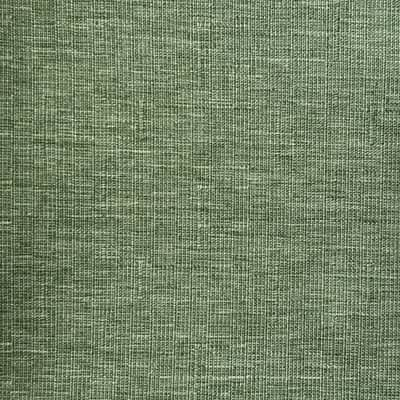
The supplied range makes the trade-off concrete. 27-MA is a green polyester-linen slub at 165 GSM, 95% polyester with 5% linen, and it is printable. Its effect is the irregular one: the slub breaks light, and the surface reads natural rather than engineered. That is a strong fit for a guestroom where the drape is meant to look grown rather than specified, provided the programme has tested how the slub reads once gathered.
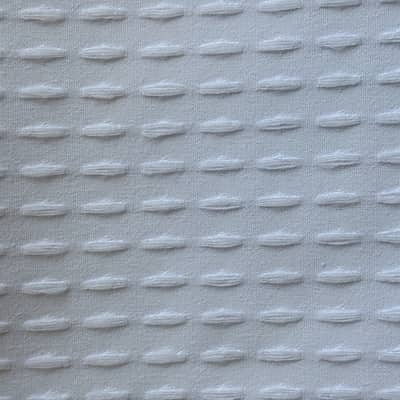
27-DS001-F is a raised dash jacquard at 185 GSM, 100% polyester, also printable. Its effect is structural rather than irregular: the dash stands proud of the ground and organises into vertical channels when the cloth gathers. In a bathroom, where the light is hard and comes from one side, that structure gives the eye something to read.
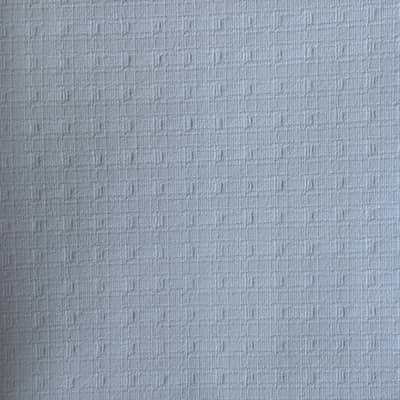
27-DS001-H is a fine grid jacquard at 190 GSM, 100% polyester, printable. Its effect is the quietest of the three: a regular cell that flattens into an almost plain ground when laid flat and only announces itself when the cloth turns. That is the surface for a programme that wants texture without a story.
These are examples of a principle, not recommendations. The point is that three printable rolls at 165, 185 and 190 GSM produce three different effects, and the weight is not what separates them.
Where the Effect Turns Into a Number
A textured yarn effect is sold as an appearance and bought as a specification, and the gap between the two is where hospitality programmes lose money. The appearance is agreed in a sample room. The specification has to survive a laundry cycle, a reorder and a second production run.
What has to be measured is narrower than a full test plan. The effect itself has to be judged in the presentation the room will show — gathered, folded, lit from one side. The surface has to be checked for how it reads after the care cycle the property will actually use, because a raised structure that softens at the fold line is a different product from the one that was approved. And the print status of the base has to be settled early, because a textured surface that cannot accept a future colourway or logo will force a re-specification at the worst moment in a hotel calendar.
What has to be priced follows from that. A heavier raised jacquard and a lighter slub are not simply two points on a price ladder; they are two different amounts of surface, and the programme is buying the amount it can defend in the room. Where the order is a pilot for a single property or a single room type, the usual reference MOQ of 2,000 m per SKU applies, and orders below that are accepted with a slightly higher unit price — which is often the cheapest way to test an effect before a group-wide commitment. The usual reference MOQ is 2,000 m per SKU; orders below 2,000 m are also accepted, with a slightly higher unit price.
What Our Own Search Rows Show, and What They Cannot
The Search Console rows supplied for this topic carry no impressions and no clicks in the last 28 days. That is a first-party observation about curtains.vip only. It does not show that hospitality buyers are uninterested in textured yarn effects, and we do not present it as evidence of market size, share, growth or direction. A zero row means the phrase did not reach our site in that window; it says nothing about the wider market.
The wider inference — that hospitality programmes increasingly want a surface with some visible structure rather than a flat ground — is a reading of how these briefs arrive at our desk, not a measured trend. Treat it as a hypothesis to test against your own programme, not as a statistic.
The Sample Question That Settles the Effect
Before a textured base is approved, one question does most of the work: can the supplier show the shortlisted roll gathered or folded in the presentation the room will actually show it, under the project's own lighting, and retain a reference panel from that same roll for the next delivery?
If the answer is yes, the effect is testable and the second order can be judged against evidence rather than against a memory of a sample table. If the answer is no, the programme is buying a shadow it has never seen. Shaoxing Haowen Textile Clothing Co., Ltd. (the company behind the curtains.vip team) develops curtain, shower-curtain and table-linen fabrics and can be reached through /contact to discuss which presentation a shortlisted effect should be tested in.
Questions buyers ask
Does a textured yarn effect change the weight a hospitality programme should specify?
Not directly. The supplied rolls show that effect and weight move independently: a 165 GSM slub, a 185 GSM raised dash and a 190 GSM fine grid produce three different surfaces. Specify the effect you can defend in the room, then confirm the weight band that delivers it.
Can a textured hospitality base still be printed later?
Print status is product-specific. Of the examples here, 27-MA, 27-DS001-F and 27-DS001-H are listed as printable; other textured rolls in the range are not. Confirm print status on the exact SKU before a future colourway or logo is promised.