
A Contract Curtain Fabric Specification, Written Backwards From the Approval Meeting
This is a planning scenario, not a client case. A contract buyer has a fixed appearance for a guestroom drape and no agreed way to write the specification. The note follows the brief from requirements to shortlist, sample plan, quotation inputs and approval, and names the one answer still missing.

PRODUCTS
Products in this report

Fine Grid Jacquard Fabric
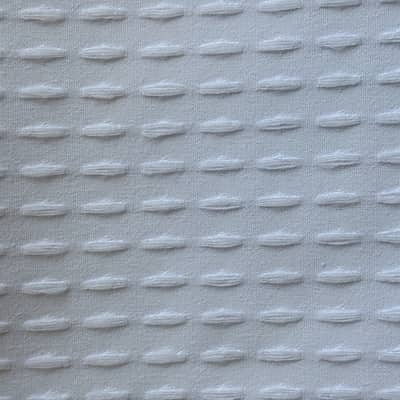
Raised Dash Jacquard Fabric
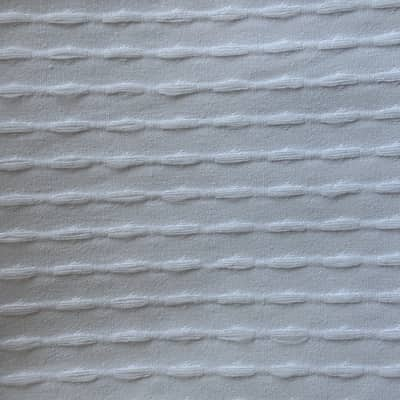
Vertical Dash Jacquard Fabric
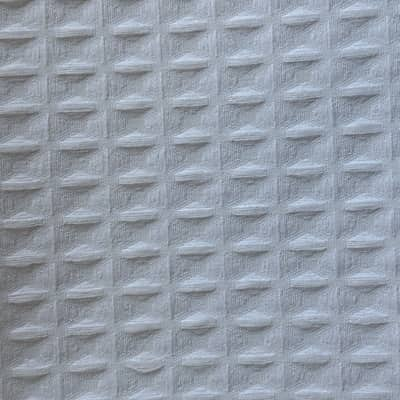
Diamond Jacquard Fabric
The Brief: A Fixed Appearance, an Unfixed Specification
A contract buyer is fitting out a mid-range guestroom block and the interior team has already closed the visual question. The drape should read as a soft white surface with a fine, regular structure — visible at close range, quiet from the doorway — and it must sit behind a sheer without competing with the bed linen. The buyer has three photographs, a paint chip and a rail width. What the buyer does not have is a specification: no weight band, no construction language, no decision on whether the cloth must accept a print later, and no agreed method for comparing two rolls that photograph the same.
This is a planning scenario, not a client case. It is the situation most contract curtain fabric specification work actually starts from — an appearance that has been approved by people who will never read a mill sheet, handed to a buyer who has to turn it into something a supplier can quote and a second delivery can be judged against. The gap between those two documents is where the brief has to be built.
Turning an Appearance Into Requirements a Mill Can Answer
The photographs describe a surface, not a cloth. The first translation is structural: a fine regular grid at close range points toward a jacquard rather than a plain weave or a print, because the structure has to exist in the yarn before anyone can approve it. From there the buyer can write requirements that a supplier can actually respond to — construction family, a weight band wide enough to allow a real shortlist, and a stated position on print.
The print question is the one buyers most often leave open, and it is the one that reshapes the shortlist most. A guestroom block of this kind frequently returns two or three years later wanting a logo, a colourway or a seasonal refresh. If the specification does not say whether the base must remain printable, the shortlist will contain rolls that cannot carry that next chapter, and the buyer will discover it at the worst moment. Naming the print position early costs nothing and removes a whole class of later re-specification.
Forming the Shortlist: Three Grid Jacquards and What Separates Them
With the requirements written, the shortlist narrows quickly to structured white jacquards in the 180–195 GSM band. Three verified rolls sit in that group, and they are close enough on paper that the differences only matter once the brief is applied.
27-DS001-H is a 190 GSM 100% polyester fine grid jacquard, printable. It is the closest literal match to the appearance brief: a fine regular grid, a polyester base, and a print option retained. 27-DS001-F is a 185 GSM 100% polyester raised dash jacquard, also printable, and it would be rejected against this brief for a specific reason rather than a general one — the raised dash reads as a directional grain, and a guestroom drape gathered at the heading will organise that grain into vertical bands the interior team did not approve. 27-DS001-E is a 195 GSM 90/10 polyester-cotton vertical dash jacquard, printable, and it sits at the top of the weight band; it stays on the list as the heavier option if the rail and the drop turn out to need more body, but it is not the default.
A fourth roll, 27-DS001-A, a 180 GSM 100% polyester diamond jacquard, is printable and would be selected for a different brief — one where the diamond motif is the point rather than a quiet ground. Against this appearance it is too legible at the doorway, which is exactly the rejection reason the buyer needs to be able to state.
The Sample Plan: What Each Candidate Has to Prove
A flat swatch cannot answer this brief, because the brief is about how a fine grid reads once the cloth is gathered. The sample plan therefore has to test presentation, not just surface. Each shortlisted roll should be cut to a panel at the finished drop, gathered at the heading at the fullness the project will actually use, and viewed under the corridor and guestroom lighting the property will install — not the sample room lamp.
Two further checks belong in the same request. First, a retained reference panel from the exact roll that will ship, so the second delivery has something to be measured against. Second, a statement of what the supplier can confirm about the construction of that exact SKU, because a fine grid that is not controlled run to run will read differently on the reorder even if the first panel was perfect. Where a print is possible in the programme's future, the panel should also be shown printed with a representative motif, since printable status on a sheet is a capability, not a result.
What Goes Into the Quotation Request
By this point the buyer knows enough to ask for a quotation that can be compared. The request should carry the SKU, the construction and weight as supplied, the print position, the panel dimensions and heading, the presentation the sample was approved in, and the reference panel requirement. A quotation that arrives without those anchors is a price per metre attached to a photograph, and two of them cannot be compared.
Volume assumptions belong here too, stated once and plainly. The usual reference MOQ is 2,000 m per SKU, and orders below 2,000 m are accepted with a slightly higher unit price — which matters for a buyer who wants to dress one room type before committing the block. Putting that in the quotation request rather than discovering it at order stage keeps the comparison honest.
Approval, and the One Answer Still Missing
Approval should name the SKU, the weight, the composition, the print status, the presentation condition the panel represents, and the person responsible for comparing future deliveries against the retained reference. That is a short document, and it is the difference between a specification and a memory.
For this brief, the shortlist is workable and the sample plan is defined. What is still missing is one answer from the buyer: will this guestroom block ever carry a print, logo or colourway on the drape? If yes, 27-DS001-H is the anchor and the raised-dash rolls are supporting options only where their grain has been approved in position. If no, the print requirement can be dropped and the weight band widens, which brings 27-DS001-E and its heavier hand into contention on body alone. Until that answer is written down, the specification is complete on appearance and incomplete on future.
Shaoxing Haowen Textile Clothing Co., Ltd. (the company behind the curtains.vip team) develops curtain, shower-curtain and table-linen fabrics, including custom print development, so the print question can be worked through against the same base rather than a substitute. Buyers can review the verified range at /products or send the brief and the open question to /contact.
Questions buyers ask
Can a contract curtain fabric specification be written from photographs alone?
No. Photographs can establish an appearance and a structural direction, but the specification also needs a weight band, a construction family, a stated print position and a sample presentation condition before a supplier can quote it or a second delivery can be judged against it.
Why would a printable roll be rejected from a shortlist?
Printability is a capability, not a fit. A roll can be printable and still be wrong for a brief — for example, a raised dash jacquard whose directional grain organises into vertical bands once the drape is gathered, when the approved appearance was a quiet fine grid.
What should be retained after a contract curtain panel is approved?
A reference panel cut from the exact roll that will ship, together with a written note naming the SKU, weight, composition, print status and the presentation condition the panel represents. Without it, the next delivery is compared against recollection rather than evidence.