
Cortinas Contract: Three Buyer Scenarios, Three Different Rolls on the Same Quote
A hotel replacement cycle, a retail facing and a private-label season can all be quoted from the same catalogue page and still need different rolls. This map sorts cortinas contract assortments by buyer scenario, places verified bases inside each, and closes with a shortlist framework a buyer can apply to their own range.

PRODUCTS
Products in this report
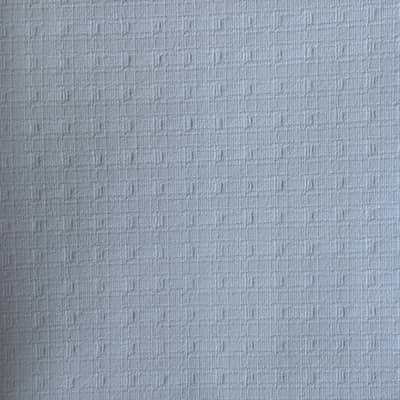
Fine Grid Jacquard Fabric
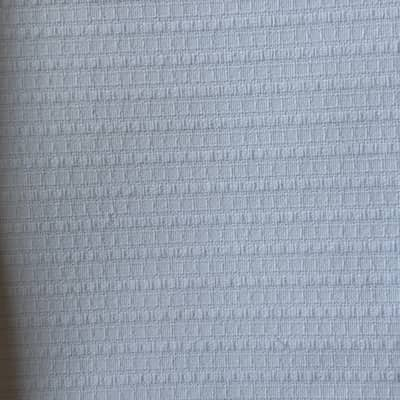
Fine Textured Jacquard Fabric
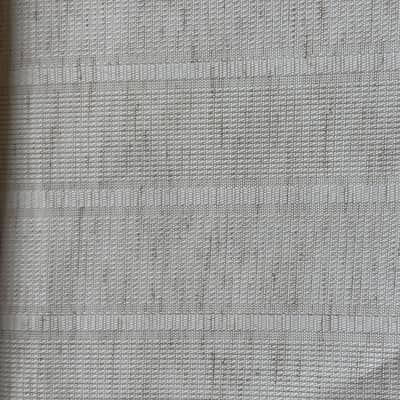
Polyester-Linen Stripe Fabric
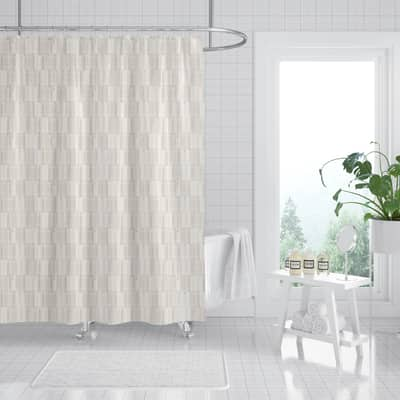
Woven Stripe
Horizontal-Slub Polyester-Linen Fabric
Raised Dash Jacquard Fabric
Vertical Dash Jacquard Fabric
The Quote That Arrives Before Anyone Has Named the Room
Three enquiries land on the same desk in the same week. A property manager needs to replace guestroom drapes on a rolling cycle and wants the surface to look like the one it replaces. A retail category buyer needs a facing that reads from three metres under store lighting. A private-label manager needs a base that can take a new colourway next season without a full re-specification. All three are asking for cortinas contract, and all three will be quoted from the same catalogue page.
The market consequence is not a fabric problem. It is a range architecture problem. If one roll is offered to all three, at least two of them will be buying a compromise they did not ask for, and the compromise usually surfaces after the first reorder rather than at the sample stage. Sorting the assortment by buyer scenario before the quotation goes out is cheaper than sorting it after the second delivery.
Hotel Replacement: The Roll Has to Look Like the One It Replaces
A replacement programme is not buying a new look. It is buying continuity. The cloth has to sit beside existing panels, under the property's own corridor and bathroom lighting, and read as the same surface two years after the original order. That makes the hotel scenario unusually intolerant of surface variation and unusually forgiving of weight differences, because nobody in a guestroom is comparing GSM.
27-DS001-H fits here as a structured anchor: a 190 GSM fine grid jacquard, 100% polyester and listed as printable. The grid gives the panel a regular surface that reads deliberate at close range, and the printable status means a future logo or colourway programme has somewhere to go. The limitation is the one that matters most in replacement work: a fine regular grid is a surface a guest can compare panel to panel, so the retained reference from the approved roll is not optional.
27-DS001-D is the quieter alternative at 180 GSM, also 100% polyester and printable. Its fine texture reads softer than a grid, which suits a property that wants the drape to recede. The trade-off is that a soft texture gives the eye less to fix on, so a slight lot-to-lot shift is harder for a housekeeper to describe and harder for a buyer to defend in a dispute. Choose it when continuity is managed by a retained panel rather than by the surface itself.
Retail Facing: The Roll Is Judged From Three Metres, Then Folded
Retail buys a hanging moment and a folded moment, and they are not the same cloth. The facing has to hold a customer's attention from a distance under store lighting; the same product then sits folded on a shelf where the fold line becomes the most visible feature. A surface with a directional structure can win the first test and lose the second.
27-008-3 is a useful case. It is a 130 GSM polyester-linen woven stripe, 92% polyester and 8% linen, natural ivory and printable. The stripe gives the facing a vertical rhythm that reads at distance without needing a print, and the printable status lets a retail programme add a seasonal motif later. The limitation is the stripe itself: a woven stripe has a direction, so cutting and folding have to respect it, and a folded stack that ignores the grain will read unevenly across the shelf.
Polyester-Linen Stripe Fabric
Woven Stripe
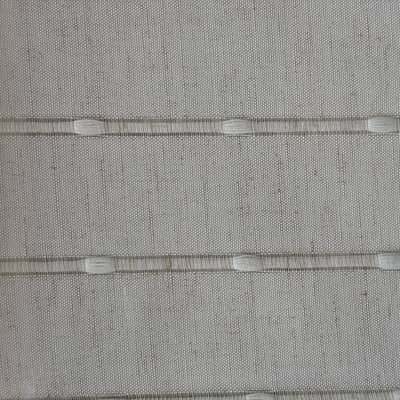
27-008-8-A sits beside it as a 140 GSM horizontal-slub polyester-linen, 96% polyester and 4% linen, also printable. The slub gives a softer, less engineered surface that folds more forgivingly than a stripe. What it gives up is the vertical read: a horizontal slub does less work for a facing viewed from the aisle, so it belongs on the shelf-led part of the range rather than the hero position.
Private Label: The Base Is Bought for the Colourway It Has Not Met Yet
A private-label programme is not buying a surface for this season. It is buying the right to change its mind next season without re-specifying the base. That reframes the shortlist: print status and surface neutrality matter more than the visual argument that wins a retail facing, and a base with a strong directional structure can become a constraint once the third colourway arrives.
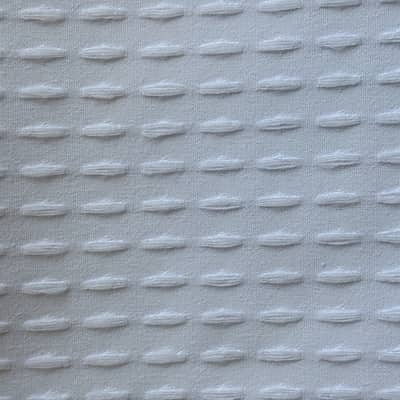
27-DS001-F is a plausible anchor at 185 GSM, 100% polyester and printable, with a raised dash structure that carries visual interest without a print. It gives a private-label range a surface that reads as designed in a plain colourway, which reduces dependence on the print file. The limitation is that a raised structure interacts with ink, so a motif approved on a flat ground should be approved again on this base in the presentation the finished panel will occupy.
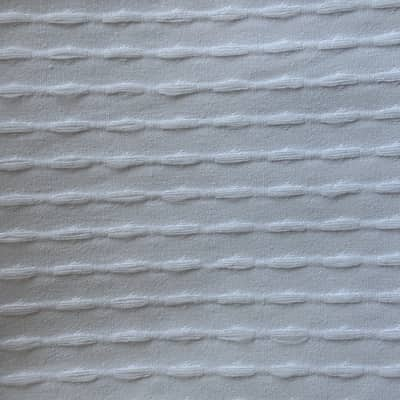
27-DS001-E is the heavier option at 195 GSM, 90% polyester and 10% cotton, printable, with a vertical dash jacquard. The cotton share and the vertical structure give it a different hand from the all-polyester rolls, which can suit a programme positioning itself on texture rather than on print. The trade-off is that a vertical dash commits the range to a direction, and every future colourway inherits it.
Where the Scenarios Refuse to Share a Roll
The temptation in a mixed cortinas contract assortment is to find the roll that satisfies everyone. In practice the three scenarios disagree on two variables, and neither is weight.
The first is surface regularity. Hotel replacement rewards a regular, comparable surface; retail facing rewards a surface with a visual argument; private label rewards a surface neutral enough to survive a colourway change. A fine grid can serve the first two and become a constraint for the third. The second is direction. A stripe or a vertical dash helps a facing and complicates a folded shelf and a seasonal print programme.
That is why a range built around one hero roll tends to widen informally over two or three seasons, as each buyer adds a SKU to solve their own problem. Mapping the scenarios first makes that widening deliberate.
What Our Own Search Rows Say, and What They Cannot
Our own Search Console rows show 23 impressions and no clicks over 28 days for cortinas contract, with an average position around 29. That is a first-party observation about searches that reached curtains.vip. It is not evidence of global or regional market size, market share, growth or direction, and we do not present it as any of those things.
Read narrowly, the row says a small number of buyers arrived with a Spanish-language contract phrase and did not find what they needed on the page they landed on. Read broadly, it says nothing about how the contract market is moving. The useful inference is editorial: buyers arrive with a scenario in mind, not a construction term, so the assortment should be explained by scenario.
A Shortlist Framework for Your Own Range
Before the next quotation goes out, name the scenarios the range actually serves and give each one a roll whose limitations are already known. A hotel replacement slot needs a regular surface plus a retained reference panel from the approved roll. A retail facing slot needs a surface with a visual argument that survives folding, which usually means checking the grain before the colour card. A private-label slot needs a printable base whose structure does not fight the next colourway.
Then test for overlap. If two rolls in the range answer the same scenario, one of them is diluting volume without widening the offer. If a scenario has no roll, the range will acquire one informally at the next sample request, usually without a specification.
Where the shortlist needs to be compared against real constructions, the fabric range at /products lists the verified SKUs with composition, weight and print status, and the team can be reached through /contact. Shaoxing Haowen Textile Clothing Co., Ltd. (the company behind the curtains.vip team) develops curtain, shower-curtain and table-linen fabrics, including custom print development, so a scenario that needs a printed base can be worked from the same conversation rather than a separate one. The usual reference MOQ is 2,000 m per SKU; orders below that are accepted with a slightly higher unit price, which matters most when a buyer is testing a new scenario slot before committing volume to it. The usual reference MOQ is 2,000 m per SKU; orders below 2,000 m are also accepted, with a slightly higher unit price.
Questions buyers ask
Can one fabric serve a hotel replacement programme and a private-label range?
It can, but the two scenarios judge it differently. A hotel programme needs a surface regular enough to compare panel to panel against a retained reference. A private-label programme needs a base neutral enough to carry a colourway it has not chosen yet. A printable fine-grid jacquard can sit in both, provided the print is approved on that exact base rather than on a flat swatch.
Does printable status mean a roll is ready for a print programme?
No. Printable status is a capability attached to the exact SKU, not a guarantee of print outcome. A raised or directional structure changes how a motif reads once the cloth is gathered, so the motif should be approved on the shortlisted base in the presentation the finished panel will occupy.
How should a buyer handle a range that serves several contract scenarios?
Map each scenario to a roll whose limitations are already written down, then check for overlap. Two rolls answering the same scenario dilute volume; a scenario with no roll will acquire one informally at the next sample request, usually without a specification attached.