
Curtain Fabric Assortment Planning: The Gaps That Appear When Every Roll Serves the Same Room
A curtain range rarely fails because it lacks fabrics. It fails because too many of them answer the same brief. This note separates what curtains.vip sees in its own search signals from wider inference, and sets out the assortment gaps worth testing.

PRODUCTS
Products in this report
The Range Looks Complete Until You Sort It by Room
Ask a buying desk to describe its curtain range and the answer usually arrives as a list of surfaces: a linen look, a jacquard, a stripe, a metallic accent. Ask the same desk to sort those rolls by the room they were bought for, and the list often collapses. Three of the four were chosen for the same kind of window, the same light, the same brief.
That collapse is the practical problem behind curtain fabric assortment planning. Width of assortment is easy to demonstrate in a catalogue and hard to defend in a range review, because a range is not measured by how many rolls it holds. It is measured by how many distinct buying decisions it can answer without two SKUs competing for the same one.
The question worth asking before the next range review is not which fabrics are missing. It is which end uses are currently unserved, and whether any two rolls in the range would be shortlisted by the same buyer for the same window.
What Our Own Search Signals Show, and What They Cannot
One honest constraint applies to anything we write about demand. The search rows we can see describe queries that reached curtains.vip. They do not describe the wider market, and they do not establish size, share or direction. Where a term shows no impressions or clicks, we treat it as an untested question rather than as evidence of demand or of its absence.
What those rows are useful for is narrower and still practical: they show which questions buyers bring to a catalogue. A buyer who arrives asking about assortment planning is usually not shopping for a single roll. They are trying to decide how many rolls the range needs, and which jobs those rolls should be assigned. That is a planning question, and it belongs to the buyer, not to the supplier's catalogue.
Everything that follows is interpretation built on that distinction. The end-use logic is general textile reasoning. The product references are drawn only from verified specifications, and they are examples of how a buyer might respond, not proof of what the market is doing.
Where Assortment Gaps Actually Hide
Most gaps do not appear as an empty slot. They appear as a role that two rolls are quietly sharing. The clearest example is the neutral linen look. A range may carry several neutral, textured, mid-weight fabrics that all read as a soft natural surface at arm's length. In a sample room they look like choice. In a range review they are one decision repeated.
The second gap is the opposite failure: a range built entirely around the feature window. Structured jacquards, metallic accents and heavy surfaces are easy to justify individually and hard to place in volume, because most windows in most projects are not feature windows. A range with no quiet, low-structure option forces the buyer to specify a feature fabric into a background role.
The third gap is printability. Not every base takes ink, and print status is product-specific rather than a category property. A range that carries several non-printable surfaces and one printable base has effectively one printable option, whatever the catalogue count suggests. When a private-label programme asks for a new colourway, that single base becomes the whole range's constraint.
None of these gaps requires new weaving to diagnose. They require sorting the existing range by the job each roll was bought to do, and marking where two rolls land on the same job.
End Use Changes the Specification, Not Just the Colour
The reason assortment gaps matter commercially is that end use does not only change the print or the colourway. It changes which specification line the buyer negotiates first.
A full-height window in a quiet room rewards structure and weight, because the cloth has room to fall in clean vertical lines. A short drop above a radiator or a low sill rewards the opposite: a lighter, less structured cloth that will not fight a tight stack. Two rolls of similar weight can behave differently in those two positions, which is why a range that only covers one of them is narrower than its SKU count suggests.
A feature panel changes the priority again. Here surface is the point, and a metallic or raised structure is doing deliberate work. The trade-off is that such surfaces are often not printable, so a buyer who wants the same range to carry a printed story needs a second, printable base rather than a print applied to the feature roll.
Care and replacement rhythm sit on top of all of this. A hospitality programme replaces on a service cycle and needs a surface that still presents properly after repeated handling. A retail programme replaces on a shelf reset and needs a surface that reads from a hanging position under store lighting. Those are different tests, and a single roll rarely passes both convincingly.
The planning implication is that each end use should be represented by a specification profile, not by a colour. If two rolls share a profile, the range has one option where it appears to have two.
Two Verified Rolls as an Assortment Contrast
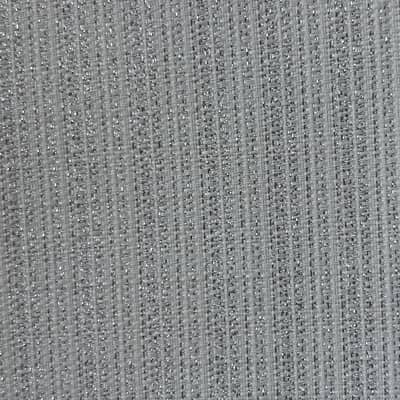
A concrete contrast makes the gap visible. Consider 27-DS001-C, a polyester-cotton fine grid at 190 gsm with a soft white surface, and 27-1759-B, a metallic-yarn linen-look fabric at 125 gsm with a silver accent. Both are supplied as shower curtain fabrics, and neither should be read as a window-curtain or table-linen product.

Polyester-Cotton Fine Grid Fabric
Metallic-Yarn Linen-Look Fabric
The fine grid is the quieter of the two and is printable. It can carry a print programme or sit as a low-structure background surface. The metallic linen-look is lighter but visually louder, and it is not printable. A buyer who wants a metallic accent and a printed story in the same range cannot solve that with one roll; the print has to live on a different base.
That is the assortment lesson in miniature. The two rolls are not better or worse than each other. They answer different briefs, and a range holding only one of them has a gap that will surface at the first project that needs the other.
What to Test Before Adding Width
Adding a roll is easy; removing a duplicate is harder, which is why the test should come before the addition.
First, assign every candidate roll to one primary end use and one replacement rhythm. If two rolls land on the same pair, treat them as one option and decide which stays. Second, confirm the print status of each base you intend to carry, because printability is product-specific and a range's print flexibility is set by its printable bases, not by its total count. Third, check that the quiet end of the range is represented at all, since background windows usually outnumber feature windows in a project.
Where a pilot is needed before a range commitment, the usual reference MOQ is 2,000 m per SKU, and orders below that are accepted with a slightly higher unit price. That is a planning fact rather than a threshold, and it is often what makes a single-property or single-door test possible before a wider roll-out. The usual reference MOQ is 2,000 m per SKU; orders below 2,000 m are also accepted, with a slightly higher unit price.
curtains.vip develops curtain, shower-curtain and table-linen fabrics, including custom print development and finished shower curtain OEM/ODM, so a range question can be worked through against more than one category. Shaoxing Haowen Textile Clothing Co., Ltd. (the company behind the curtains.vip team) publishes the specification lines — weight, composition and print status — that make the sorting exercise above possible without a sample room visit.
Three Implications to Watch Next
The first is duplication. If a range review finds two rolls that would be shortlisted by the same buyer for the same window, the range is carrying cost without carrying choice. Watch whether removing one changes any real buying decision.
The second is print concentration. A range with one printable base has a single point of failure for every future colourway or private-label story. Watch how many printable bases sit in the range before the next print programme is promised.
The third is the quiet end. Watch whether the range can dress an ordinary window without reaching for a feature fabric, because that is the specification most projects will actually order in volume. None of these is a forecast. They are three checks that can be run against a live range before the next commitment.