
The Surface Decides Before the Artwork Does: Ordering Custom Printed Curtain Fabric
A buyer who says they need to order custom printed curtain fabric is usually holding a motif and a room, not a specification. This field note moves from what can be seen on a roll to what has to be measured, tested and priced, and closes on the one sample question that settles the order.

PRODUCTS
Products in this report
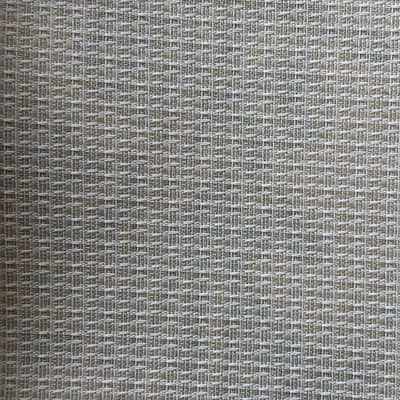
Crosshatch Linen-Look Fabric
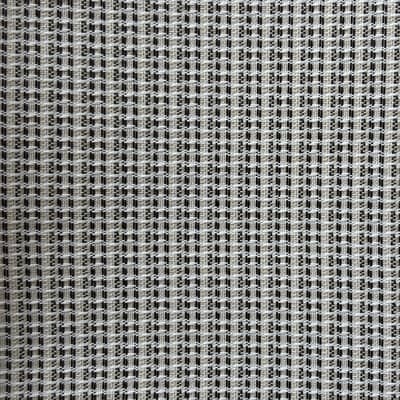
Contrast Grid Linen-Look Fabric
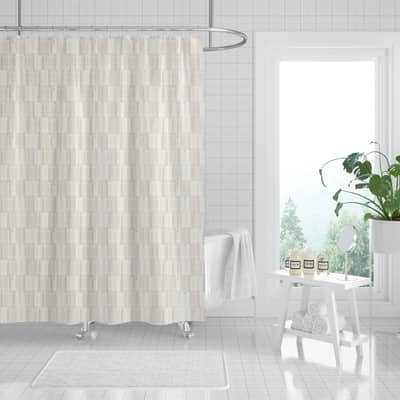
Woven Stripe
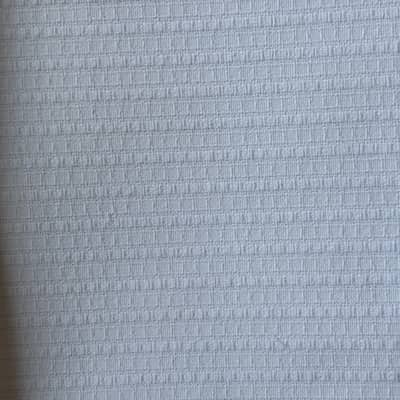
Fine Textured Jacquard Fabric
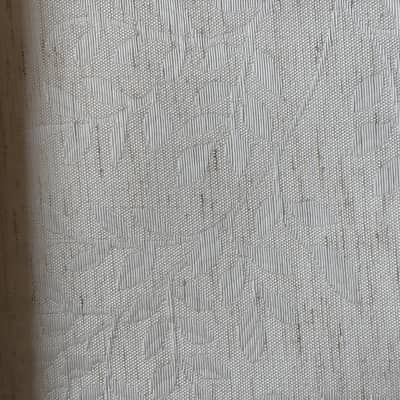
55 Large Floral Jacquard Fabric
A Slub Catches Light Differently Once the Cloth Is Gathered
Lay a metre of a linen-look base flat on a cutting table and run a palm across it. The slub breaks the light into small uneven patches, and from a metre away the surface reads quiet and even. Gather the same metre onto a rail at the width the finished curtain will actually be pulled to, and those patches start to organise themselves into vertical bands. Nothing about the yarn has changed. The viewing condition has.
That shift is the first practical problem behind the phrase I need to order custom printed curtain fabric. The buyer is usually holding two things at once: a motif and a room. The motif has been approved on a screen or a flat panel. The room will see the cloth hanging, folded, backlit or lit from one side. A custom print order is therefore not a print order first. It is a base decision that the print then has to survive.
What the Roll Shows and What Only a Test Shows
A buyer can see composition, weight and surface structure on a specification sheet, and can feel hand and drape on a swatch. What the sheet does not show is how the base behaves once ink sits on it and the panel is cut, hemmed and hung. Print status is the clearest example. Two linen-look rolls can sit at the same 155 GSM, in the same natural register, on the same 100% polyester construction, and only one of them accepts ink. 27-001-E is a printable crosshatch linen-look at 155 GSM; 27-001-C-1 is a contrast-grid linen-look at the same weight and composition that is not printable. On a screen they are near-interchangeable. In a print programme they are not.
Crosshatch Linen-Look Fabric
Contrast Grid Linen-Look Fabric
The second thing a sheet does not show is how a directional surface behaves after printing. A woven stripe or a grid has an axis, and the axis is set at the loom. A motif printed over a striped ground can read as a deliberate overlay or as a registration problem, depending on where the repeat lands relative to the stripe. This is not a colour question and it is not a weight question. It is a construction question that has to be answered before the print file is released.
Where the Surface Stops Being an Aesthetic Choice
Printing changes the base in ways that are visible at arm's length. Ink sits on the surface, so a slub that reads as soft irregularity in a natural tone can read as noise under a dense motif. A fine jacquard that carries its own shadow can compete with a print rather than support it. 27-DS001-D is a fine-textured jacquard at 180 GSM, 100% polyester and printable; 55# is a large floral jacquard at 165 GSM, 95% polyester and 5% linen, also printable. Both can take ink. The question is whether the buyer wants the print to dominate the surface or to sit inside it.
Fine Textured Jacquard Fabric
55 Large Floral Jacquard Fabric
There is also a commercial edge to this. A base that is already carrying a strong structure is doing part of the visual work before the print arrives, which can allow a simpler, lower-coverage motif. A flatter base gives the motif more room but asks more of the artwork. Neither is better in the abstract. The choice changes the artwork brief, the sampling round and the price conversation, and it is cheaper to settle before the file is finalised than after the first strike-off.
End Use Rewrites the Same Base Decision Three Times
A hotel replacement programme buys a surface that has to read the same after a service cycle, so the print is usually a quiet mark on a consistent ground. A retail programme buys a hanging product that has to read from three metres under store lighting, so the print is often the product's main visual argument and the base is chosen to let it carry. A private-label programme buys the right to change the motif next season, which makes print status a range decision rather than a product decision.
Those three briefs can shortlist the same roll and still ask different questions of it. The hotel asks whether two panels from different production runs read the same. The retailer asks whether the motif still reads at the distance a customer stands. The private-label manager asks whether the base can accept a new colourway without a full re-specification. When a range contains only one printable base, every future colourway depends on that single SKU, and that concentration is worth pricing before the promise is made.
What Has to Be Measured, Tested and Priced
Once the base is shortlisted, the order becomes a set of measurements rather than a preference. Usable width after selvedge and trim, the repeat position relative to the cut line, the panel count per roll under the actual heading, and the print status of the exact SKU all belong in the specification before the quotation is compared. A quotation that names only a price per metre is not yet comparable to another quotation, because the two may assume different trim allowances or different base specifications.
Sampling is where those numbers get tested rather than assumed. A flat swatch can confirm tone and hand. It cannot confirm how the motif reads once the panel gathers, how a directional ground behaves after printing, or whether the surface still reads as deliberate at the distance the finished curtain will be seen. The sample that matters is the one taken from the roll the buyer intends to order, printed with the actual motif, and viewed in the position the finished product will occupy.
What Our Own Search Rows Show, and What They Cannot
One search row for custom printed curtain fabric reached curtains.vip in the last 28 days, with no click and a position around 11.5. That is a first-party observation about our own site, not evidence of global or regional demand, market size or direction, and we do not present it as any of those things. It tells us that at least one buyer arrived with the phrase and did not find the answer on the page they landed on. That is a useful editorial signal and nothing more.
Shaoxing Haowen Textile Clothing Co., Ltd. (the company behind the curtains.vip team) develops curtain, shower-curtain and table-linen fabrics, including custom print development and finished shower curtain OEM/ODM. Where a buyer is working across more than one end use, that range allows a single print-development conversation to be run against several bases rather than one. The usual reference MOQ is 2,000 m per SKU, and orders below that are accepted with a slightly higher unit price, which lets a buyer test one base against one motif before committing a range. Buyers can review the range at /products or raise a specific brief at /contact. The usual reference MOQ is 2,000 m per SKU; orders below 2,000 m are also accepted, with a slightly higher unit price.
Questions buyers ask
Can any printable base carry any motif?
No. Print compatibility is product-specific. A base can accept ink and still change the way a motif reads once it is gathered, particularly where the ground carries its own structure or a directional stripe. The motif should be tested on the exact SKU, not on a generic printable swatch.
Does a heavier base always print better?
Weight is not the deciding variable. A 180 GSM fine jacquard and a 125 GSM metallic-yarn linen-look behave differently under ink for reasons of surface and structure, not mass alone. The base should be chosen against the presentation the finished curtain will actually be seen in.