
Print Repeat Scale for Shower Curtain Collections: The Decision That Sits Between Artwork and Base Cloth
Repeat scale is usually settled inside the artwork file, before anyone asks how wide the curtain is or how much it gathers. This note separates what our own search rows can show from wider inference, then works through the specification consequences and the risks of getting the scale wrong.

PRODUCTS
Products in this report
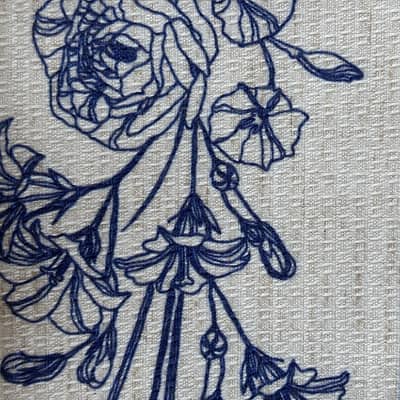
27-001-F Navy Floral Polyester-Linen Fabric
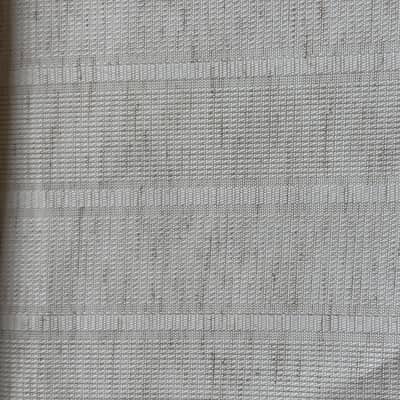
Polyester-Linen Stripe Fabric
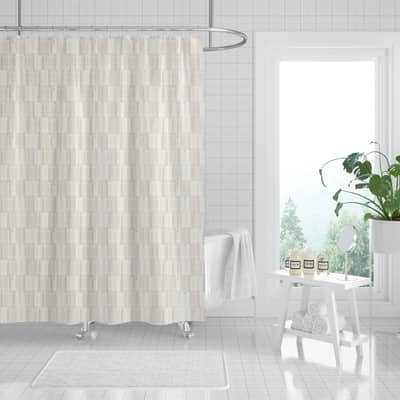
Woven Stripe
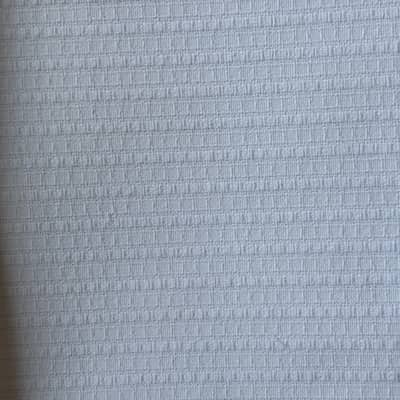
Fine Textured Jacquard Fabric
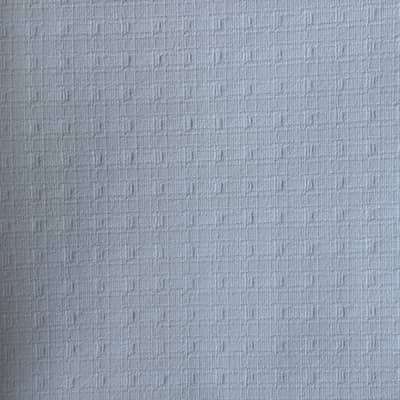
Fine Grid Jacquard Fabric
The Repeat That Looks Right Flat and Wrong on a Rail
A print file is approved on a screen or a flat panel, where the repeat is a fixed geometry. A shower curtain is not flat. It hangs from a rail, gathers at the heading, and is pulled across an opening that is narrower than the cloth. The moment the panel gathers, the horizontal scale of the repeat compresses and the vertical scale does not. A motif that reads as a balanced all-over on the flat can read as a dense vertical stripe once the curtain is closed.
This is the practical problem behind print repeat scale for shower curtain collections. It is not a question about how large a flower should be. It is a question about how the repeat behaves when the cloth is gathered, how many times it crosses the usable width, and whether the buyer is approving the flat version or the hung version. The two are not the same object, and the gap between them widens as the repeat gets larger.
What Our Own Search Rows Show, and What They Cannot
Searches for print-related terms have reached curtains.vip, but the rows we hold describe our own site, not the wider market. They tell us which questions buyers bring to our catalogue. They do not establish market size, share, growth or direction, and we do not treat them as evidence of a trend. The signal is narrower and more useful: buyers arrive with a print brief and a base-cloth question attached to it, and the repeat scale is often the part of the brief that has not been decided.
That distinction matters for anyone reading this as a demand note. A first-party search row is an observation about our own traffic. Wider inference about how the shower-curtain category is moving belongs to a different kind of evidence, which we do not have here. What we can say is that the repeat-scale question keeps arriving attached to a base-cloth question, and the two are usually settled in the wrong order.
Where the Scale Decision Actually Belongs
Repeat scale is normally fixed inside the artwork file, because that is where it is easiest to change. In a shower-curtain collection it belongs one step earlier, at the point where the buyer decides how much of the width the motif should occupy and how the panel will be gathered. A large-scale repeat and a small-scale repeat do not fail in the same way, and they do not fail on the same base.
A small repeat tolerates gathering because the eye reads it as texture rather than as a motif. It also tolerates a busy base, because the surface structure and the print are working at similar frequencies. A large repeat does the opposite. It needs a quiet ground, enough usable width to complete the motif without a visible cut, and a gathering ratio that does not crush the horizontal dimension. Buyers who treat scale as an aesthetic preference rather than a width-and-gather decision usually discover the problem at installation, when the panel is already sewn.
Two Verified Bases, Two Different Repeat Behaviours
The base cloth sets the ceiling on how fine a repeat can read. 27-001-F-PRINT, a 150 GSM polyester-linen at 92% polyester and 8% linen, is a printed floral in navy and is listed as printable. Its surface already carries a fine linen-look irregularity, so a small repeat sits into that texture rather than competing with it. A large repeat on the same base has to fight the slub for attention, and the result depends heavily on viewing distance.
27-008-3, a 130 GSM polyester-linen woven stripe in natural ivory, shows the opposite case. The stripe is a built-in repeat, and it is printable. Any print file placed over it becomes a second repeat working against the first, which is why scale decisions on a striped base are really decisions about which of the two patterns leads. A buyer who wants the print to lead should expect to keep the motif large and simple; a buyer who wants the stripe to lead should expect the print to sit at a smaller scale, closer to texture.
Polyester-Linen Stripe Fabric
Woven Stripe
For a collection that needs a quiet ground, 27-DS001-D at 180 GSM and 27-DS001-H at 190 GSM are both 100% polyester jacquards with a fine texture or fine grid, and both are printable. Their structure is regular enough that a medium repeat reads cleanly across the face, which makes them useful reference points when the buyer is trying to decide whether the base or the artwork is causing a scale problem.
The Commercial Consequences of Getting Scale Wrong
A repeat that is too large for the usable width creates a cutting problem before it creates a design problem. If the motif does not complete cleanly across the panel, the cutter either centres it and accepts an asymmetric edge, or shifts the layout and accepts a wider trim loss. Both outcomes change the yield, and yield is the number that decides whether the collection holds its margin at the agreed price.
The second consequence is reorder risk. A collection built on one printable base at one repeat scale has a single point of failure. If that base is discontinued or the repeat has to be rescaled, every SKU in the range moves with it. A collection that carries the same motif at two scales across two printable bases can absorb a base change without redrawing the artwork, which is a cheaper form of flexibility than it looks.
This is also where the usual reference MOQ becomes relevant. At curtains.vip, 2,000 m per SKU is the usual reference MOQ, and orders below 2,000 m are accepted with a slightly higher unit price. That structure allows a buyer to pilot one motif at one scale on one base before committing the full collection, which is the sensible way to test a scale decision that cannot be judged from a screen.
What to Test Before the Scale Is Frozen
The test that settles most scale arguments is a gathered panel, not a flat swatch. Ask for the intended motif printed on the intended base, then hung or gathered at the ratio the finished curtain will actually use, under the lighting the product will actually meet. A flat panel can confirm colour and registration. It cannot confirm how the repeat reads once the cloth compresses.
The second test is a width check. Measure how many complete repeats cross the usable width after the heading, side hems and eyelet spacing have taken their share, and decide whether a partial motif at the edge is acceptable. If it is not, the scale has to change before the artwork is released, not after the first delivery.
The third test is a reference panel from the approved roll. Without it, the second production run is judged against memory, and a small scale shift that would be invisible on a flat swatch becomes visible on a gathered panel. Shaoxing Haowen Textile Clothing Co., Ltd. (the company behind the curtains.vip team) develops curtain, shower-curtain and table-linen fabrics, including custom print development, which means the scale conversation can be held against a specific base rather than in the abstract.
Three Things to Watch Next
First, watch whether the collection's repeat scale has been approved on a flat panel or a gathered one. If the approval record does not name the gathering ratio and the viewing distance, the scale is still an assumption.
Second, watch how many printable bases in the range can carry the same motif at the same scale. One base is a concentration risk; two bases give the collection somewhere to move if the first is unavailable.
Third, watch the edge. A repeat that completes cleanly across the usable width is a specification decision that costs nothing at the artwork stage and a great deal at the cutting table. It is worth settling before the first panel is sewn, not after.
Questions buyers ask
Does a larger print repeat always require a heavier base cloth?
Not necessarily. Weight and repeat scale are separate variables. What a large repeat needs is a quiet ground and enough usable width to complete the motif. A fine-textured jacquard at 180 GSM can carry a medium repeat cleanly, while a slubby base at a similar weight can make a large motif read unevenly because the surface irregularity competes with the print.
Can the same print file be used at two different repeat scales?
Yes, and this is one of the cheaper forms of flexibility in a shower-curtain collection. Carrying the same motif at two scales across two printable bases means a base change does not force a full artwork redraw. The scales have to be tested separately on a gathered panel, because they behave differently once the cloth compresses.