
Three Table Linen Briefs, One Roll: Where Hospitality Table Linen Fabric Actually Diverges
A hotel banquet manager, a retail buyer and a private-label programme manager can approve the same table linen roll for three unrelated reasons. This note maps where those briefs diverge, which verified bases sit closest to each, and where one roll quietly stops working.

PRODUCTS
Products in this report
The Banquet Manager Counts Covers, the Retail Buyer Counts Facings
A hotel banquet manager replaces a tablecloth when the cloth has been through enough laundry cycles that the surface stops presenting properly. A retail buyer replaces it when the shelf reset arrives and the previous colourway stops earning its facing. A private-label programme manager replaces it when the brand needs a new chapter, whether or not the cloth has worn out at all.
Those are three different clocks, and they pull the same hospitality table linen fabric in three directions. The banquet manager wants a surface that still looks deliberate after repeated service. The retail buyer wants a cloth that reads well folded on a shelf, because that is where the purchase decision happens. The private-label manager wants a base that can carry a new print or colour story next season without the base itself becoming the variable.
Most sourcing trouble starts when a buyer writes one brief and expects it to satisfy all three. It rarely does, and the failure is usually quiet: the roll passes the sample table and then underperforms in the one job nobody wrote down.
What a Hotel Programme Is Really Buying
Hotel table linen is judged in service, not in a sample bag. The cloth has to sit flat, hold a fold, and keep its surface legible under warm dining light after the first few laundry cycles. That pushes a hotel brief toward a base with enough substance to hang straight and enough surface interest to hide the small irregularities that appear with use.
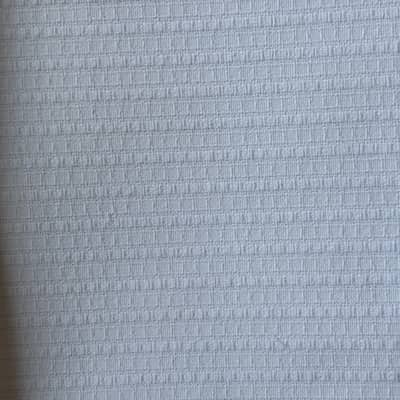
A fine textured jacquard such as 27-DS001-D fits that brief well. It is 100% polyester at 180 GSM and printable, so a property can take a plain white base and add a woven-in texture that reads as considered rather than plain. The limitation is equally clear: at 180 GSM it is a substantial cloth, so a buyer specifying a light summer terrace cover or a stacked buffet presentation may find it heavier than the setting wants.
Where the hotel brief goes wrong is treating texture as decoration. In a dining room, texture is doing a job: it breaks up the flatness that makes a plain cloth look tired first.
Retail Buys the Folded Moment
A retail table linen buyer is not buying a dining surface. They are buying a product that has to survive a shelf, a photograph and a customer's hand. The cloth is folded, banded and stacked, so the surface has to read at a glance from a hanging or stacked position, and the colour has to hold across a range without the range looking repetitive.
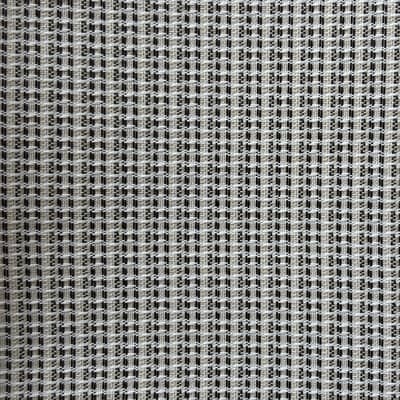
Contrast and colour-yarn structures suit this brief better than a subtle jacquard. 27-001-C-1 is a 100% polyester contrast grid at 155 GSM, and the black accent gives the folded cloth a graphic edge that survives a shelf. It is not printable, which is the trade-off: a retail buyer who wants a seasonal print story on the same base cannot have it, and should treat this roll as a colour-led item rather than a print carrier.
The retail mistake is over-weighting the base. A heavier cloth feels premium in the hand, but it also folds bulkier, photographs flatter and costs more per unit on a shelf where the customer is comparing against three other cloths at the same ticket.
Private Label Buys the Right to Change
A private-label programme is buying optionality. The base has to be stable enough to reorder unchanged, and plain enough that next season's print or colour direction is a decision about the print, not about the cloth underneath it.
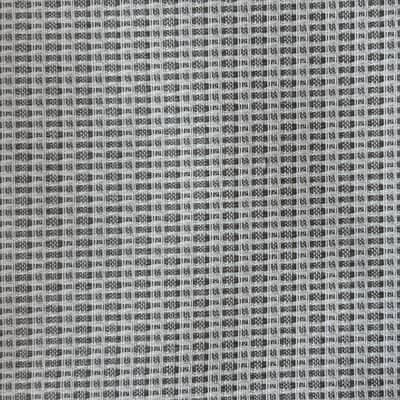
That points toward a printable base with a quiet surface. 27-001-B is a vertical-stripe polyester-cotton linen-look fabric at 160 GSM and printable, so a programme can run one stripe base across several seasons and let the print or the colourway carry the change. The limitation is that the stripe is a direction: a programme that later wants a plain ground, or a print that fights a vertical line, will need a second base rather than a rework of this one.
This is where a private-label brief most often gets muddled with a retail brief. Retail buys the surface that sells now. Private label buys the base that will still be reorderable after the surface has changed twice.
Where One Roll Quietly Stops Working
The temptation is to find the roll that serves all three briefs and standardise on it. Sometimes that works, and the honest answer is that it works less often than the range plan assumes. A cloth that is heavy enough for a banquet floor is usually bulkier than a shelf wants. A cloth with a strong graphic accent is usually too directional for a programme that needs to change its story next season.
The duplication problem is subtler than a repeated SKU. Two rolls can sit in the same range doing the same job in the same clock, which dilutes volume without widening the offer. A hotel jacquard and a retail grid are not duplicates even when they share a weight band, because they answer different questions. Two printable neutrals at 155 and 160 GSM often are duplicates, and the range pays for that in slower reorders.
Our own Search Console rows for table-linen terms have reached curtains.vip, but the volumes are small and the rows describe our own site rather than the wider market. They tell us which questions buyers bring to our catalogue. They do not establish market size, share or direction, and we do not read them as a trend. The useful signal is narrower: buyers arrive with a surface in mind and a brief they have not fully separated.
A Shortlist Framework for Your Own Range
Before shortlisting hospitality table linen fabric, assign every candidate roll to one primary clock: hotel replacement, retail reset or private-label season change. A roll that cannot be assigned is usually a roll that will sit in the range without a buyer.
Then test three things. First, can the roll be reordered at the same specification, which is where the usual reference MOQ of 2,000 m per SKU becomes relevant, since orders below that are accepted with a slightly higher unit price and a pilot run is a legitimate way to test a property or a single retail door. Second, does the surface still do its job in the position it will actually occupy, folded on a shelf or laid on a table. Third, does the roll duplicate another SKU's role in the same clock. The usual reference MOQ is 2,000 m per SKU; orders below 2,000 m are also accepted, with a slightly higher unit price.
Shaoxing Haowen Textile Clothing Co., Ltd. (the company behind the curtains.vip team) develops curtain, shower-curtain and table-linen fabrics, including custom print development, and the bases discussed here sit in that range. The unresolved question worth carrying into your next brief is not which roll is best, but which clock each roll is actually serving. Answer that first and the specification usually writes itself.