
Two Printed Tablecloth Rolls, One Print File: Where Hospitality Print Registration Actually Breaks
Two printed tablecloth rolls can carry the same artwork and still fail a hotel dining room differently. This technical note follows the print through the base, the sample table and the acceptance decision, using two verified rolls with different constructions.

PRODUCTS
Products in this report
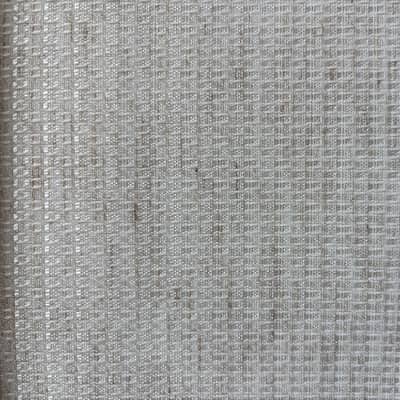
Polyester-Linen Textured Fabric
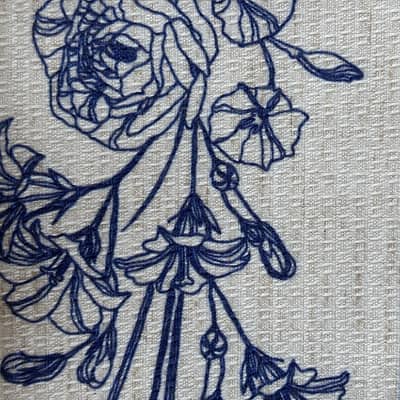
27-001-F Navy Floral Polyester-Linen Fabric
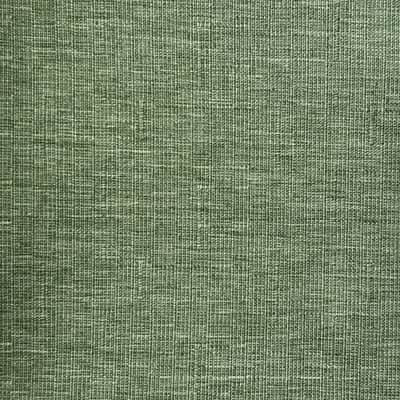
Green Polyester-Linen Slub Fabric
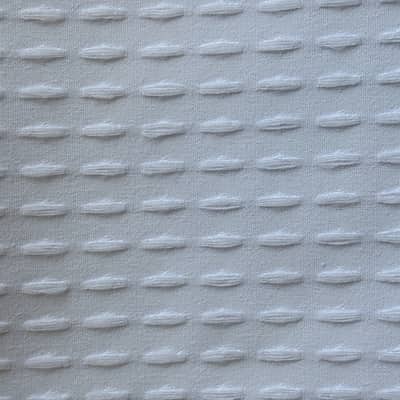
Raised Dash Jacquard Fabric
The Same File, Two Different Tables
Two rolls sit side by side in a supplier's sample room. Both are printed with the same navy floral repeat, both are quoted at the same price per metre, and both look correct on a screen. On a hotel dining table, one will hold a crisp motif through a two-hour service; the other may show a slightly softer edge where the ink meets a slub. The practical question that separates them is not colour accuracy or GSM. It is whether the base construction can hold the print registration your table setting depends on.
That question belongs to the buyer, not the printer. A print file is fixed. The base is not. When a hospitality programme specifies printed tablecloth fabric, it is choosing a surface that will be folded, stacked, wiped and re-laid many times per week, and the print has to survive that routine without drifting into a different visual character.
What the Base Does to the Ink Before the Printer Touches It
Print registration is usually discussed as a machine setting. In practice, the base decides how much of that setting matters. A flat, tightly constructed weave presents an even plane to the print head, so the motif lands where the file says it should. A slub or a raised jacquard presents a surface with height variation, and the ink follows that variation rather than the artwork.
This is why two rolls with the same composition percentage can behave differently under the same print file. The variable is not the fibre; it is the geometry of the surface the fibre creates. For a tablecloth, that geometry is visible at arm's length on a set table, which is a far more demanding viewing distance than a curtain panel seen across a room.
Two Verified Rolls Compared on Construction, Not Weight
The 27-001-F Navy Floral Polyester-Linen Fabric (SKU 27-001-F-PRINT) is a 150 GSM printed base at 92% polyester and 8% linen, supplied as a printable fabric with a navy floral design already applied. Because the print is part of the supplied product rather than a development step, the buyer's comparison is between this finished printed roll and a base that would need printing separately.
Polyester-Linen Textured Fabric
27-001-F Navy Floral Polyester-Linen Fabric
The 27-MA Green Polyester-Linen Slub Fabric (SKU 27-MA) is a 165 GSM base at 95% polyester and 5% linen, printable, with a slub surface. It is not supplied as a printed tablecloth; it is a base that a print programme would have to carry. The 15 GSM difference between the two is the least interesting number here. The more consequential difference is that one arrives with a print and a flat-ish hand, while the other arrives with a textured surface that will interact with any ink applied later.
A third reference point is the 27-DS001-F Raised Dash Jacquard Fabric (SKU 27-DS001-F), a 100% polyester base at 185 GSM, printable, with a raised dash structure. It is heavier and more three-dimensional than either of the other two, which makes it a useful control when a buyer wants to see how much surface relief a printed tablecloth can tolerate before the motif starts to read as texture rather than pattern.
- 27-001-F-PRINT: 150 GSM, 92% polyester / 8% linen, printable, supplied with a navy floral print.
- 27-MA: 165 GSM, 95% polyester / 5% linen, printable, slub surface, no print supplied.
- 27-DS001-F: 185 GSM, 100% polyester, printable, raised dash jacquard, no print supplied.
The Sample Table Test
A swatch tells you what a print looks like in the hand. A table tells you what it looks like in service. The difference is the fold. When a printed tablecloth is folded for storage and unfolded for a setting, the print crosses the fold line, and any surface relief in the base will show up as a faint interruption in the motif along that line.
A practical sample test is to lay a full metre of the shortlisted roll flat on a table, fold it in half along the print repeat, leave it folded for a short period, then open it and view the motif from a standing position at the edge of the table. On a flat printed base such as 27-001-F-PRINT, the fold line should be visually quiet. On a slub base such as 27-MA, the slub itself may create a slight irregularity that is part of the intended look, but the buyer has to decide whether that irregularity reads as natural texture or as a print defect in a formal dining room.
This test does not measure performance, and it does not predict how a print will behave over a long service life. It answers a narrower question: does the base construction support the visual standard the venue has set for its table settings?
Where the Acceptance Decision Actually Sits
The acceptance decision for a printed hospitality tablecloth is usually written as a colour approval. That is too narrow. The more useful acceptance note names the exact SKU, the base construction, the GSM, and the print status of the roll being approved, and it states which surface characteristic the venue has accepted as part of the design.
For a programme built on 27-001-F-PRINT, the acceptance note can reference the supplied print directly, because the print is part of the product. For a programme built on 27-MA or 27-DS001-F, the acceptance note has to separate the base approval from the print approval, because the print is a development step applied to a surface that already has its own character. Mixing those two approvals into one signature is where reorder disputes begin.
One limitation worth validating before any of this is settled: the supplied product data does not include a width figure for these rolls. A tablecloth cutting plan depends on usable width, so that number should be confirmed in writing before the sample round is treated as complete.
What to Put in the RFQ
A useful RFQ for printed tablecloth fabric for hospitality names the SKU, the base construction, the GSM, the print status, and the surface characteristic the venue has accepted. It also states the target table size and the number of settings per table, because those two facts determine whether a fold line will fall inside the visible print area.
Sampling should be requested against the exact SKU under consideration, not a similar roll from the same family. Where a programme is likely to repeat, the sample approval should be written so that a later bulk order can be checked against it without renegotiating the surface standard.
Shaoxing Haowen Textile Clothing Co., Ltd. (the company behind the curtains.vip team) supplies these rolls as part of a range that includes curtain, shower-curtain and table-linen fabrics, with custom print development and finished shower curtain OEM/ODM. The usual reference MOQ is 2,000 m per SKU, and orders below that are accepted with a slightly higher unit price, which lets a venue test a printed tablecloth base on a small table count before committing to a full dining room. The usual reference MOQ is 2,000 m per SKU; orders below 2,000 m are also accepted, with a slightly higher unit price.
The next step is to review the roll options at /products and send a sample request through /contact that names the SKU, the print status and the table setting the fabric has to serve.
Questions buyers ask
Can a slub tablecloth base carry a fine printed motif as cleanly as a flat base?
The supplied product data does not include a print-quality rating for either roll, so this cannot be answered from the specification sheet alone. The practical approach is to print the actual motif on the shortlisted base and view it on a set table, since surface relief affects how a fine motif reads at that distance.
Should the base and the print be approved separately for a hospitality tablecloth programme?
Where the print is supplied as part of the product, as with 27-001-F-PRINT, the approval can reference that product directly. Where the print is a development step applied to a base such as 27-MA or 27-DS001-F, separating the base approval from the print approval gives a cleaner reorder reference.
Does GSM decide which printed tablecloth roll suits a hotel dining room?
GSM is one input, but construction is the more decisive variable for print registration. The 150 GSM printed roll and the 165 GSM slub base differ by only 15 GSM, yet their surfaces interact with ink very differently.