
Shrinkage Testing on a Shower Curtain Roll: What the Hem Tells You Before the Lab Does
Shrinkage rarely shows up on the roll. It shows up at the hem, the eyelet line and the second production run. This field note moves from what a buyer can see on a shower curtain base to what has to be measured, tested and priced, using verified rolls as comparison evidence.

PRODUCTS
Products in this report
The Hem That Draws Up After the First Wash
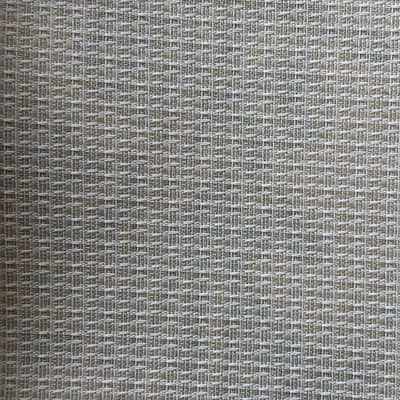
A shower curtain base laid flat on a cutting table looks settled. The crosshatch on 27-001-E reads as a fine even grid, the surface catches light in small patches, and the roll end squares cleanly. Nothing in that view suggests movement. Then the finished panel goes through a laundry cycle, the hem draws up by a centimetre or two, and the eyelet line no longer sits parallel to the rail.
That is where shower curtain fabric shrinkage testing stops being a lab formality and becomes a buyer decision. The buyer is not choosing a fibre. They are deciding whether the panel geometry they approved will still be the panel geometry the property receives after the first wash, the tenth wash, and the replacement order two years later. A base that reads correctly and moves unpredictably is not a shortlist candidate.
What the Roll Shows, and What Only a Wash Test Shows
A buyer can observe several things on a roll without any test: the surface structure, whether the weave is directional, whether the selvedge is tight or relaxed, and whether the cloth has been heat-set into a flat hand. What the roll cannot show is how much of that structure will relax once the cloth meets water and heat.
Shrinkage in a polyester-dominant shower curtain base is largely a function of how the yarn was drawn and how the cloth was finished, not of the weight printed on the spec sheet. Two rolls at the same GSM can move differently because one was relaxed during finishing and the other was not. That is why a wash test at the buyer's actual cycle matters more than a generic shrinkage figure quoted by the mill.
For a hotel programme, the cycle is the property's laundry or a commercial laundry. For a retail programme, it is the domestic machine the end customer owns. For a private-label programme, it is whichever cycle the care label promises. Those are three different tests, and a panel that passes one may fail another.
Where the Movement Actually Shows Up on a Finished Curtain
Shrinkage is rarely uniform across a shower curtain panel. The heading area, where the cloth is folded and stitched, behaves differently from the open body. The hem, with its double fold, behaves differently again. A base that moves two percent in the body can move more at a stitched edge because the thread and the cloth relax at different rates.
The practical consequence is that a buyer should specify shrinkage against the finished panel, not against a flat swatch. The question is not how much the cloth shrinks in isolation. It is whether the finished curtain still clears the floor line, still aligns at the eyelets, and still matches the panel length of the previous production run.
Three Verified Bases, Three Different Movement Conversations
27-001-E is a 155 GSM 100% polyester crosshatch linen-look base, printable, with a fine even grid. Its structure is tight and its surface is quiet, which makes it a reasonable candidate where the panel geometry has to hold across a long replacement cycle and the print programme may arrive later.
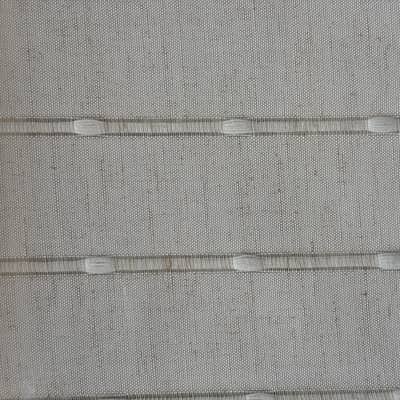
27-008-8-A is a 140 GSM 96% polyester and 4% linen horizontal-slub base, also printable. The linen content and the slub structure give it a softer hand, but the irregular yarn means the cloth relaxes less predictably than a uniform weave. A buyer testing this base should test it at the actual cycle, because the slub can mask early movement on a flat panel.
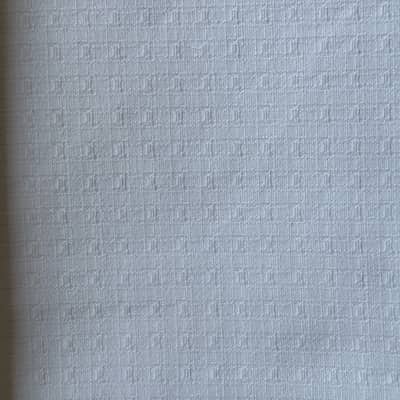
27-DS001-C is a 190 GSM 88% polyester and 12% cotton fine grid, printable, with more mass and a firmer hand. Heavier bases generally move less in the body, but the cotton content and the denser structure change how the cloth behaves at a stitched hem. Weight alone does not settle the shrinkage question; it only changes which part of the panel is at risk.
These three are comparison evidence, not a ranking. Each one answers a different brief, and each one has to be tested against the cycle the finished curtain will actually see.
What Has to Be Measured, Tested and Priced
Before a shower curtain base is approved, three numbers belong in the specification file. The first is the shrinkage figure at the buyer's actual cycle, measured on a panel cut to the finished size rather than on a loose swatch. The second is the shrinkage allowance built into the cut plan, stated in centimetres rather than as a percentage assumption. The third is the tolerance the supplier is willing to commit to across repeat orders.
Pricing follows from those three. A base with a tight, uniform structure and a stable finishing route is easier to repeat, and that repeatability is worth more than a small difference in unit price. A base with a softer hand or an irregular yarn may need a larger allowance, which changes the cut yield and therefore the real cost per finished curtain.
This is also where the commercial terms belong. The usual reference MOQ is 2,000 m per SKU, and orders below that are accepted with a slightly higher unit price, which lets a buyer run a pilot panel through the actual laundry cycle before committing a full programme. The usual reference MOQ is 2,000 m per SKU; orders below 2,000 m are also accepted, with a slightly higher unit price.
Where Our Own Search Rows Sit, and Where They Stop
Searches for shower curtain fabric shrinkage testing have reached curtains.vip, but the volumes involved are small and the rows describe our own site, not the wider market. They tell us which questions buyers bring to our catalogue. They do not establish market size, share, growth or direction, and we do not treat them as evidence of a trend.
The useful signal is narrower. Buyers arrive with a panel geometry in mind and a wash cycle they cannot avoid, and they want to know whether the base they are shortlisting will still fit that geometry after the first wash. That is a specification question, and it is answerable with a sample and a test rather than with a market forecast.
The Sample Question That Settles Approval
Before the base is approved, one question does most of the work: can the supplier cut a finished-size panel from the exact roll you are shortlisting, run it through the cycle your care label will promise, and report the movement at the hem, the heading and the body separately?
If the answer is yes, the shrinkage allowance becomes a measured number rather than an assumption, and the second production run can be judged against evidence. If the answer is no, the panel geometry is being approved from a flat swatch, and the movement will be discovered at installation rather than at the sample table. Shaoxing Haowen Textile Clothing Co., Ltd. (the company behind the curtains.vip team) develops curtain, shower-curtain and table-linen fabrics, including custom print development and finished shower curtain OEM/ODM, and can work the test against the cycle the programme intends to run. The next step is to review the range at /products or send the cycle specification through /contact.
Questions buyers ask
Does a higher GSM mean less shrinkage on a shower curtain base?
Not reliably. Weight changes how the cloth hangs and how much mass sits at the hem, but movement depends mainly on how the yarn was drawn and how the cloth was finished. A 190 GSM base and a 155 GSM base can move differently at the stitched edge even when the body shrinkage is similar. Test the finished-size panel at the actual cycle rather than inferring from the weight band.
Should shrinkage be tested on a flat swatch or a finished panel?
A finished panel is the more useful test for a shower curtain, because the heading fold, the hem and the eyelet line all relax at different rates from the open body. A flat swatch tells you how the cloth behaves in isolation; a finished panel tells you whether the curtain will still clear the floor line and align at the eyelets after washing.
How does shrinkage affect the cut plan and the price?
The shrinkage allowance is added to the cut length, so a base that moves more requires a longer cut per panel and reduces the usable panel count per roll. That changes the real cost per finished curtain, not just the price per metre. A base with a tight, uniform structure and a stable finishing route is easier to repeat, and that repeatability is usually worth more than a small unit-price difference.