
Table Linen Drape and Table Edge Appearance: The Corner Is Where a Cloth Tells the Truth
A tablecloth is judged at the corner, where the cloth turns from a flat field into a hanging edge. This field note works from that observation into the construction and cut decisions behind table linen drape and table edge appearance, and closes on the one sample question that settles approval.

PRODUCTS
Products in this report
The Corner Is the Only Part of the Cloth Nobody Can Hide
Square a cloth over a table and most of it lies flat and says very little. The centre is a field, the surface is whatever the weave makes it, and under a warm lamp it reads as one tone. Then the cloth reaches the corner. Here it has to do two things at once: turn ninety degrees without puckering, and fall from the tabletop into a vertical edge that hangs straight rather than flaring, twisting or collapsing against the leg.
That corner is where table linen drape and table edge appearance stop being separate questions. A roll can drape beautifully along a long side and still fail at the corner, because the corner is where the cloth's own weight, its structure and the way it was cut all meet. Buyers who approve a cloth flat on a sample table never see this. Buyers who approve it laid on a table of the actual size and height see it immediately.
What Weight Buys, and What It Merely Postpones
Weight is the first thing a buyer reaches for when a cloth will not hang. A heavier cloth falls with more authority, resists a draught, and holds a fold along the edge. That is real, and it is why banquet floors often move up the weight band when a lighter cloth starts to look untidy after service.
But weight is a blunt instrument at the corner. A heavy cloth that is too stiff will not turn cleanly; it stands away from the table at the corner and casts a small shadow, and the edge reads as a fold rather than a fall. A lighter cloth with a softer hand can turn neatly and still hang straight, provided the cut is square and the drop is consistent. The useful question is not how heavy the cloth is but whether its weight is distributed the way the corner needs — enough body to fall, not so much that the turn fights back.
This is why a weight band alone rarely settles a table linen brief. Two cloths at the same gramme weight can behave differently at the corner if one is tightly woven and the other carries a raised structure. The number describes the cloth in the hand. The corner describes it on the table.
Structure Shows Up at the Edge Before It Shows Anywhere Else
A raised jacquard, a slub or a fine grid reads quietly across the flat of a table. At the hanging edge it reads differently, because the edge presents the cloth side-on and the structure starts to cast small shadows down the drop. On a structured base, that can be an asset: the edge looks deliberate, and the cloth carries a visible material quality from across a room. On a cloth that is meant to read calm and plain, the same structure at the edge can look busy.
The cut matters as much as the weave here. A cloth cut slightly off-square will hang with one corner lower than the others, and no amount of weight corrects it. A cloth cut square but hemmed with uneven tension will pull at one corner and release at another, so the edge waves. Neither fault is visible on a roll. Both are visible the moment the cloth is laid.
This is where a table-linen programme diverges from a curtain programme. A curtain is gathered and its irregularities are absorbed by the folds. A tablecloth is laid flat and its edge is a straight line the eye can follow. The tolerance for a wavy hem is much tighter on a table than on a rail.
Where a Verified Base Makes the Trade-Off Concrete
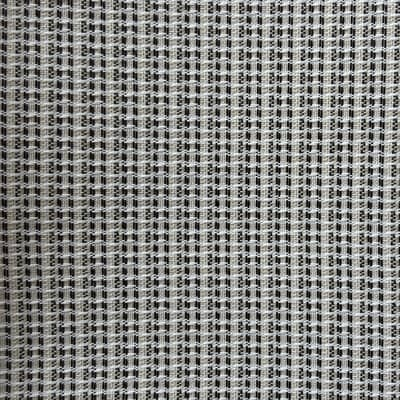
Two rolls from the current range illustrate the split without recommending either. 27-001-C-1 is a 155 GSM 100% polyester contrast grid linen-look, non-printable, with a black accent running through the grid. Laid on a table it reads as a quiet natural ground; at the edge, the grid gives the drop a faint regularity that reads as considered rather than plain. Because it cannot take a print, its role in a range is the stable, unprinted option — the cloth that earns its place on surface and drape rather than on future colourways.
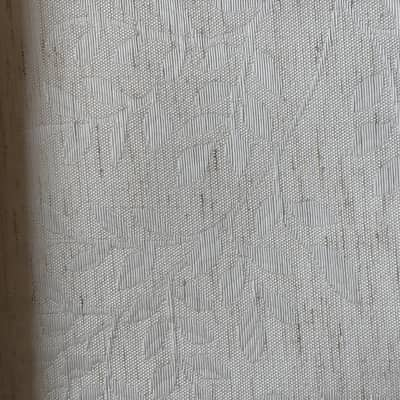
Set against it, 55# is a 165 GSM blend of 95% polyester and 5% linen carrying a large floral jacquard in a natural ivory, and it is printable. The weight sits close to the contrast grid, but the surface does something different at the corner: the large motif breaks across the turn, and the edge reads as patterned rather than as texture. For a buyer, the choice is not heavier versus lighter. It is whether the table edge should carry a visible motif or a quiet structure, and whether the cloth needs to accept a print later.
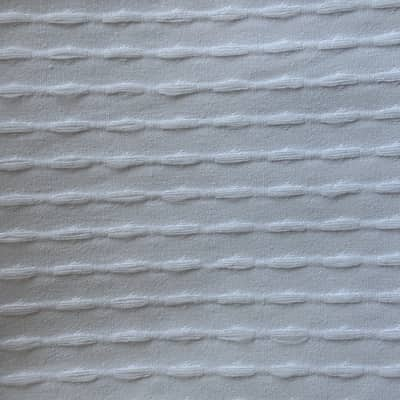
A third case sits further out. 27-DS001-E is a 195 GSM polyester-cotton vertical dash jacquard, printable, and noticeably heavier than either of the others. On a long banquet table that extra body helps the edge fall straight and stay straight through service. On a small restaurant table it can read as too much cloth, and the corner turn becomes harder to keep clean.
The Buyer Scenarios That Change Which Property Wins
A banquet operation strips and re-lays cloths in rotation, and judges the edge at the end of service when the cloth has been dragged and stacked. There, a cloth that holds its drop after handling is worth more than one that photographs well when new. A restaurant with a printed identity judges the cloth at close range under directional light, and the edge has to carry the motif without the hem breaking the repeat. A retail or private-label programme judges the cloth folded on a shelf, where the edge is a folded line rather than a hanging drop, and the question becomes whether the cloth creases in a way that reads as natural or as tired.
These three briefs do not rank weight, structure and cut in the same order. A programme that tries to serve all three with one roll usually ends up with a cloth that is acceptable everywhere and convincing nowhere. The more useful exercise is to name which property each end use is actually paying for, then check whether the range has a roll that delivers it.
What to Measure, Test and Price Before the Cloth Is Approved
Drape and edge appearance are judged by eye, but they can be made testable. The first step is to lay the candidate cloth on a table of the size and height the programme will actually use, not a sample table. The second is to look at the corner specifically: whether it turns without puckering, whether the drop is even on all sides, and whether the edge hangs straight or flares. The third is to leave the cloth laid for the length of a service and look again, because a cloth that settles badly shows it after an hour, not after a minute.
Pricing follows from the same observations. A cloth that needs a wider hem to hang straight, or a heavier weight to hold its drop, carries more metres per cover than a lighter cloth that behaves. That difference belongs in the comparison before the unit price is read, not after. Where a programme expects a future print or colourway on the table, the printable status of the base belongs in the same conversation, because a cloth that drapes correctly and cannot carry the next design will force a re-specification later.
The Question That Settles the Sample
Before a table linen base is approved, one question does most of the work: can the supplier lay the shortlisted cloth on a table of the programme's own size and height, show the corner turned and the edge hanging as it will in service, and retain a reference panel from that same roll for the next delivery? If the answer is yes, drape and edge appearance become something a buyer can compare against evidence rather than against a memory of a sample table. Shaoxing Haowen Textile Clothing Co., Ltd. (the company behind the curtains.vip team) develops curtain, shower-curtain and table-linen fabrics, and the verified range at /products lists the constructions with composition, weight and print status for that comparison. If the answer is no, the corner will be settled later, on the buyer's floor, with no reference to judge it against.