
Teal Canopy: What a Six-Impression Search Row Can and Cannot Tell a Shower-Curtain Buyer
A buyer asking for a teal canopy is usually describing a look, not a specification. This note separates the small first-party search signal at curtains.vip from wider inference, works through what a colour-led brief demands of a shower-curtain base, and closes on what to test rather than what to forecast.

PRODUCTS
Products in this report
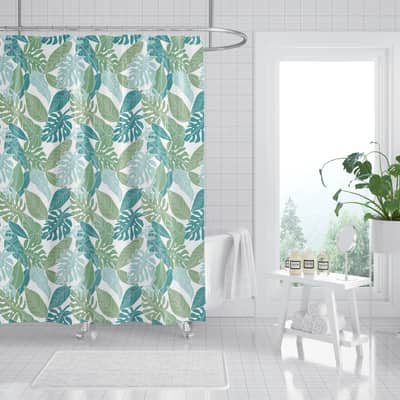
Teal Canopy
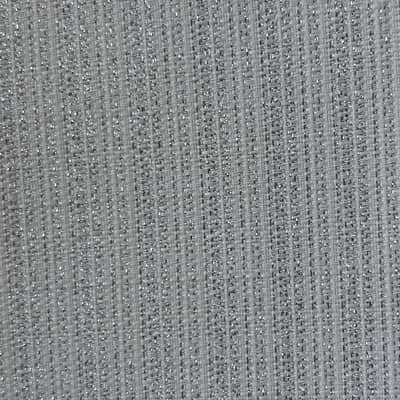
Metallic-Yarn Linen-Look Fabric
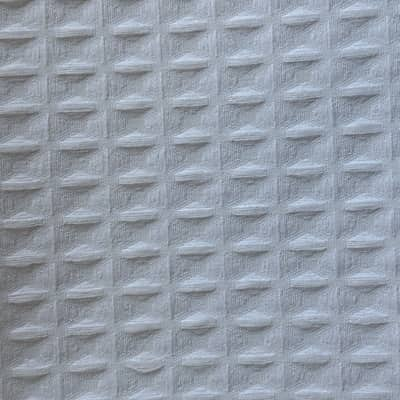
Diamond Jacquard Fabric
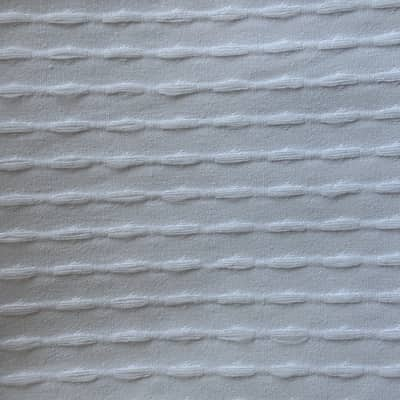
Vertical Dash Jacquard Fabric
The Brief Arrives as a Colour, and the Colour Is the Easy Part
A buyer writes in with two words: teal canopy. Behind those words sits a picture — a bathroom where the curtain reads as a soft blue-green field, gathered at a rail, holding its colour under a hard downlight while a white basin and a stainless fitting sit in front of it. The buyer has the picture. What they do not yet have is a specification, because teal is a target and a canopy is a presentation, and neither one tells a mill which roll to cut.
That gap is worth taking seriously rather than smoothing over. Colour-led briefs are common in shower-curtain sourcing, and they fail in a predictable way: the shade is approved on a flat swatch under a sample-room lamp, the roll is cut, and the finished panel reads a shade colder or flatter once it is gathered and lit by a bathroom fixture the buyer never specified. The question this note works through is not what teal canopy means globally. It is what a buyer should do with a colour-led request before a roll is shortlisted.
What Our Own Search Row Shows, and Where It Stops
On curtains.vip, the phrase teal canopy produced six impressions and no clicks in the last 28 days, at an average position around eight. That is a first-party observation about our own site and nothing more. Six impressions is a very small number. It cannot support a claim about market size, growth, share or direction, and we do not read it as one. It is equally wrong to call it demonstrated demand and wrong to dismiss it as noise.
What it does suggest, cautiously, is a shape of enquiry: a buyer arriving with a colour and a visual idea rather than a construction term. That is consistent with how colour-led briefs usually reach a mill. It is inference, not measurement, and it should be treated as a hypothesis to test against a buyer's own enquiry log rather than as a finding.
Why a Colour Brief Strains a Printable Base
The commercial difficulty with a teal canopy request is that colour is the part of the specification most likely to change. A hotel programme may want the same surface in a different shade for a second phase. A retail range may want the teal for one season and a warmer neutral for the next. A private-label buyer may want a logo or a motif dropped onto the same ground. Each of those futures asks the base to accept ink.
That is where the shortlist narrows quickly. A non-printable roll can deliver a teal surface if the colour is dyed or woven in, but it cannot absorb the next colourway without a re-specification. A printable base keeps that option open, at the cost of a surface that has to be tested with the actual colour rather than a generic swatch. Neither choice is universally right. The decision belongs to how many seasons the programme expects to run on the same base.
Three Verified Rolls as Boundary Cases
The verified range offers useful contrast here, not as a recommendation but as a way to see where the trade-off sits. 27-1759-B is a 125 GSM linen-look base, 88% polyester and 12% metallic yarn, with a silver accent and no print status. It is the lightest of the group and the one whose surface carries its own visual argument. 27-DS001-A is a 180 GSM diamond jacquard, 100% polyester and printable, with a raised texture that will interact with any colour laid over it. 27-DS001-E is a 195 GSM vertical dash jacquard, 90% polyester and 10% cotton, also printable, and the heaviest of the three.
Read together, they show the real question behind a teal canopy brief. A lighter, non-printable surface gives a clean colour field but little room to change. A heavier printable jacquard gives the programme a future colourway, but the raised structure will break a flat teal into light and shadow once the panel is gathered, and that has to be seen before approval rather than after. The metallic accent on the linen-look base raises a third issue: a silver yarn under a teal ground reads differently from the same yarn under a neutral, and the interaction is a sample question, not a catalogue one.
The Presentation the Colour Will Actually Meet
A teal canopy is a hanging object. The colour a buyer approves flat is not the colour a guest sees. Gathered at a heading, the cloth turns through folds, and each fold presents the surface at a different angle to the light. On a flat ground the effect is modest. On a structured jacquard it is pronounced, because the structure already casts its own small shadows and the colour sits on top of them.
This is the part of the brief most likely to be under-specified. The useful test is not a larger swatch. It is a finished-size panel, in the intended colour, gathered at the rail width the product will actually be pulled to, viewed under the lighting the room will actually use. Where that test has not been run, the approval is a decision about a flat surface that the buyer will only meet again in service.
What to Test Next, and What Remains Open
Three things are worth putting in front of a supplier before a teal canopy brief is shortlisted. First, ask whether the candidate base is printable on that exact SKU, and ask for the intended colour on that base rather than on a generic swatch. Second, ask for the panel gathered and lit as the finished product will be, because a colour that holds flat can still break at the fold. Third, ask which roll in the range is expected to carry the next colourway, and whether more than one printable base can do it — a single printable base is a concentration risk worth naming early.
What stays open is the demand question. Our own six impressions do not answer it, and no responsible reading of a single site's search rows can. A buyer with a real teal canopy enquiry in hand has better evidence than we do, and the useful move is to compare it against their own log rather than against a market forecast. Where a comparison against real constructions is needed, the fabric range at /products lists the verified SKUs with composition, weight and print status, and the team at /contact can discuss a specific brief. Shaoxing Haowen Textile Clothing Co., Ltd. (the company behind the curtains.vip team) develops curtain, shower-curtain and table-linen fabrics, including custom print development, and the usual reference MOQ is 2,000 m per SKU, with orders below that accepted at a slightly higher unit price. The usual reference MOQ is 2,000 m per SKU; orders below 2,000 m are also accepted, with a slightly higher unit price.