
Approving a Textile Golden Sample: What the Signed Panel Is Actually For
A golden sample is usually signed as proof that the fabric is right. It is better understood as a reference for the next argument. This memo works through the brief, the trade-offs, the shortlist logic and the handoff that decide what the signed panel should contain.

PRODUCTS
Products in this report
The Panel That Gets Signed on the Last Day of the Trip
The approval meeting is usually the last item on a sourcing trip. The buyer has three days of mill visits behind them, a flight that evening, and a quality manager waiting for a decision. A panel is laid on the table, the light is whatever the sample room has, and someone asks whether this is the one. Signing it feels like closing the question. In practice it opens a different one: what will this panel be used for when the second delivery arrives and nobody in the room remembers the conversation.
That is the real decision behind how to approve a textile golden sample. The buyer is not only judging a piece of cloth. They are deciding what evidence the panel will carry forward, who will be allowed to compare against it, and which variables are frozen by the signature. Get that wrong and the golden sample becomes a source of dispute rather than a settlement.
What the Signature Freezes, and What It Leaves Open
A signed panel fixes a surface. It does not automatically fix the base, the production lot, the finishing route or the colour approval that preceded it. Buyers who treat the golden sample as a complete specification usually discover the gap at the second delivery, when the surface reads close but the cloth behaves differently under the needle or on the rail.
The useful distinction is between a reference for appearance and a reference for construction. An appearance reference answers whether the next roll reads the same. A construction reference answers whether it is the same cloth. Most programmes need both, and most golden samples only carry the first unless the buyer writes the second into the approval note. That note is where the real work sits, and it costs nothing at the meeting to add the SKU, the weight band, the composition and the print status beside the signature.
Three Briefs, Three Different Reasons to Sign
A hotel programme signs a golden sample to protect a replacement cycle. The panel has to answer a question two years later, in a corridor with different lighting, when a housekeeping manager reports that the new panels do not match the old ones. For this brief the panel's value is repeatability, and the buyer should be willing to trade a small amount of surface interest for a base that is likely to still be available and still read the same.
A retail buyer signs for a different reason. The panel has to predict how the product reads from the distance a shopper actually stands at, which is rarely the distance of a sample-room table. A surface that looks refined under a warm lamp can flatten into a plain colour under store lighting, and the golden sample is the only artefact that can be re-checked against that condition.
A private-label programme manager signs to buy the right to change the motif later. Here the panel is less about the surface in front of them and more about whether the base can carry the next print or colourway. A golden sample approved on a non-printable base quietly closes that option, and the cost only appears when the brand wants a second chapter.
Where Buyers Over-Specify the Panel
The opposite failure is common enough to be worth naming. Some buyers try to make the golden sample carry every test result, every colour reading and every performance claim the programme might ever need. The panel becomes a folder, and the folder becomes a substitute for a decision. That is expensive in time and it does not improve the evidence, because a single panel cannot represent lot variation.
A more useful approach is to decide which two or three variables the signature is actually protecting, and to leave the rest to the specification sheet. If the risk is colour drift across lots, the panel is a colour reference and should be stored accordingly. If the risk is surface change after finishing, the panel should be taken from production, not from a hand-finished sample. If the risk is that the base disappears, the panel proves nothing at all and the conversation belongs with the supplier's range planning instead.
Shortlist Logic Before the Panel Is Cut
The golden sample is the end of a shortlist, not the beginning of one. By the time a panel is cut, the buyer should already have narrowed to a construction family and a weight band, and should know whether the base is expected to accept ink at some point in its commercial life. Two verified bases illustrate how differently that plays out without either being a recommendation.
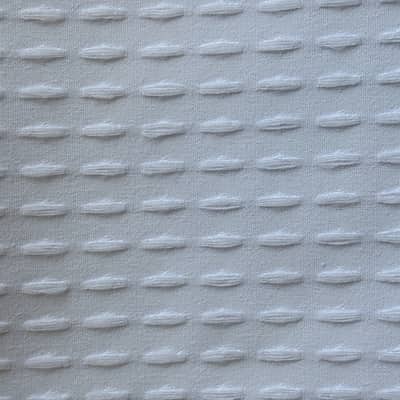
27-DS001-F is a 185 GSM raised-dash jacquard in 100% polyester, printable, with a white texture that carries visible structure. A programme that signs this panel is freezing a surface where the structure is part of the product's argument, which makes the approval note more demanding: the panel has to show the structure at the scale the finished curtain will present it, not flattened on a table.
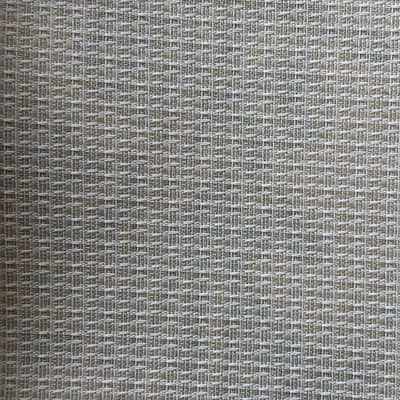
27-001-E is a 155 GSM crosshatch linen-look in 100% polyester, also printable, with a quieter natural surface. A programme that signs this panel is protecting a calmer read, and the risk it is guarding against is different: not structure loss, but the drift of a neutral tone across lots. Both panels can be correctly signed and still require different storage, different comparison conditions and different language in the approval note.
Validation: What the Panel Can and Cannot Prove
A golden sample can prove that one piece of cloth existed in one condition on one day. It cannot prove that the next production run will match it, that the finishing route is stable, or that the surface will survive the end use. Those are separate questions, and each needs its own evidence: a production panel rather than a sample-room panel, a lot comparison rather than a single reference, and an end-use test rather than a visual check.
This is also where the buyer's own obligations sit. The supplier can control the roll. The buyer controls the brief, the approval note and the comparison discipline after delivery. A programme that retains a reference panel but never compares against it has paid for the sample and received none of its value. A programme that compares against a panel stored in the wrong light has created a dispute it cannot win.
It is worth noting what our own site data can and cannot say here. Searches for approval and quality-control terms have reached curtains.vip, but the volumes are small and the rows describe our own traffic, not the wider market. They tell us which questions buyers bring to our catalogue. They do not establish market size, share or direction, and we do not treat them as evidence of a trend.
The Handoff: Who Keeps the Panel and Who Compares Against It
The commercial handoff is usually the weakest link. The panel is signed at the mill, travels home in a suitcase, and ends up in a drawer. The quality team that will inspect the second delivery never sees it. The merchandiser who wrote the purchase order does not know which variables the signature protected. The result is an inspection that measures what is easy to measure rather than what was actually approved.
A workable handoff names three things in the approval note: the SKU and its construction facts, the presentation condition the panel represents, and the person or role responsible for comparing future deliveries against it. Where the programme involves a future print, colourway or logo, the printable status of the base belongs in the same note, because a base that reads correctly and cannot carry the next chapter will force a re-specification later.
Shaoxing Haowen Textile Clothing Co., Ltd. (the company behind the curtains.vip team) develops curtain, shower-curtain and table-linen fabrics, including custom print development and finished shower curtain OEM/ODM, so a single approval conversation can cover more than one end use. Where a programme is testing a property or a single retail door before a wider commitment, the usual reference MOQ is 2,000 m per SKU, and orders below that are accepted with a slightly higher unit price. The usual reference MOQ is 2,000 m per SKU; orders below 2,000 m are also accepted, with a slightly higher unit price.