
Roll Length Is a Cutting-Room Number, Not a Purchasing One
Buyers usually plan roll length in metres because that is how fabric is sold. The number that decides whether a programme runs efficiently is the usable panel count per roll, and it only appears once width, trim loss and the cut plan are known. This note works through the variables that change the answer and the buyer scenarios where metre planning is still the right call.

PRODUCTS
Products in this report
The Assumption That Metres Are the Planning Unit
Metres are how fabric is bought, so they become how fabric is planned. The purchase order says 6,000 m, the budget is built on 6,000 m, and the cutting room is expected to deliver the programme from it. That assumption is useful in exactly one situation: when the finished item is sold by length and the fabric is used as a continuous run with no fixed panel geometry.
It fails the moment the finished product is a fixed-size panel. A shower curtain, a curtain drop or a tablecloth is not consumed in metres. It is consumed in panels, and panels are cut from usable width. Two rolls of identical length can yield different panel counts if their usable widths differ, and two rolls of identical width can yield different panel counts if the trim allowance differs. The metre total is a purchasing fact. The panel count is a production fact, and only one of them predicts efficiency.
Where the Metre Number Stops Predicting Output
Three variables move the answer, and none of them appear on a standard quotation. The first is usable width after selvedge and side trim. The second is the panel length the cut plan actually requires, including heading and hem allowance. The third is the trim loss created by where the repeat or the surface direction falls across the width.
A buyer comparing two quotations at the same price per metre is often comparing two different panel yields. The cheaper roll can be the more expensive programme once the cut plan is drawn. This is not an argument against metre pricing. It is an argument for asking for the cut plan before the price is treated as final.
The Roll That Makes the Arithmetic Visible
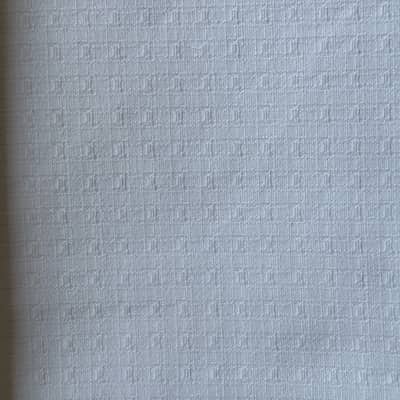
27-DS001-C is a 190 GSM polyester-cotton fine grid, printable, with a fine grid running across the face. At that weight the cloth holds a cut edge and a heading without much help, which is why it appears in programmes where the panel is the product rather than a length of cloth. The grid also gives the cutter a reference line, so the trim allowance can be read off the roll instead of estimated.
The limitation is the same thing that makes it useful. A directional surface has to be cut on one axis, so the usable width is fixed by the direction of the grid, not by the roll width alone. A buyer planning in metres will not see that constraint until the first cut. A buyer planning in panels will price it in from the start.
Two Lighter Rolls and a Different Yield Question
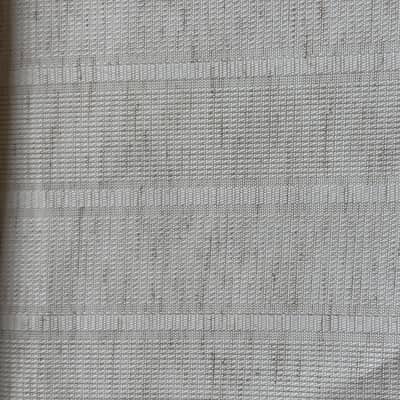
27-008-3 is a 130 GSM polyester-linen stripe, printable, in a natural ivory. At that weight the roll is easier to handle and cheaper per metre, but a lighter cloth moves more under the cutter, so the trim allowance is usually wider and the panel count per roll falls. The stripe adds a second constraint: the stripe has to land consistently on the finished panel, which effectively fixes the cut position across the width.
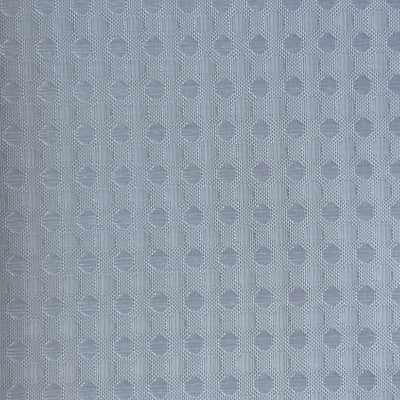
FAB-WAFFLE-DOT-120 is a 120 GSM dotted-waffle polyester, printable. The cell geometry is the whole surface, so a panel cut across the cells reads differently from a panel cut along them. Neither roll is a problem. Both are cases where the metre total tells the buyer less than the panel plan does.
These are boundary cases rather than recommendations. The point is that roll length planning for production efficiency only becomes a real calculation once the surface, the weight and the cut direction are all in the same document.
What Our Own Search Rows Show, and What They Cannot
Searches for roll length and production planning terms have reached curtains.vip, but the volumes are small and the rows describe our own site. They tell us which questions buyers bring to our catalogue. They do not establish market size, market share, growth or any wider industry trend, and we do not present them as such.
The narrower signal is more useful. Buyers arrive with a metre quantity and a finished product, and the conversation that follows is almost always about width, trim and panel count. That is a question pattern, not a market forecast.
When Metre Planning Is Still the Right Call
Metre planning holds when the fabric is sold on to someone else as roll goods, when the finished item is cut to a customer-supplied measurement on site, or when the programme is a pilot where the panel geometry is not yet fixed. In those cases the buyer is genuinely buying length, and the cut plan belongs to the next party in the chain.
It also holds for early budgeting, provided the buyer knows the number is provisional. A budget built on metres is a reasonable first pass. A production commitment built on metres is a risk, because the yield assumption has never been tested against a cut plan.
Where the brief involves a print, a colourway or a logo programme, the printable status of the base belongs in the same conversation as the yield, because a base that cuts efficiently and cannot carry the next chapter is not a shortlist candidate. Shaoxing Haowen Textile Clothing Co., Ltd. (the company behind the curtains.vip team) develops curtain, shower-curtain and table-linen fabrics, including custom print development and finished shower curtain OEM/ODM, which means the cut plan and the print plan can be worked against the same roll rather than two.
The Question That Replaces the Metre Total
Before a roll length is committed, one question does most of the work: can the supplier show the cut plan for the actual panel, at the actual usable width, on a roll from the same specification, and state the trim allowance that plan assumes? If the answer is yes, the metre total becomes a derived number rather than the planning unit, and the second order can be judged against a plan instead of a memory.
If the answer is no, the programme is being planned from a price list. The width, the trim loss and the panel count will all be settled later, at the buyer's cost.
Questions buyers ask
Should a buyer order fabric in metres or in panels?
Order in metres, because that is the commercial unit, but plan in panels. Ask the supplier for the usable width, the trim allowance and the panel count per roll before the metre total is treated as final. The two numbers are related but not interchangeable.
Does a higher GSM roll always yield fewer panels?
Not automatically. Heavier cloth usually moves less under the cutter, which can reduce the trim allowance, while lighter cloth can need a wider allowance. The net effect depends on the surface direction and the cut plan, so it has to be calculated rather than assumed.
Where does print status fit into roll length planning?
Print status decides whether the roll can carry a future colourway or logo programme, which affects how much of the roll length is worth committing to a single design. A non-printable base has to earn its place on surface alone. Print compatibility is product-specific and should be confirmed per SKU.