
Warp and Weft Density in Decorative Fabrics: The Number Buyers Rarely Ask For
Threads per centimetre is the specification most decorative-fabric buyers never request, and the one that quietly explains why two rolls at the same GSM behave differently on a rail, at a cut line and on a reorder. This note separates what a first-party signal can show from wider inference, then sets out the questions worth testing.

PRODUCTS
Products in this report
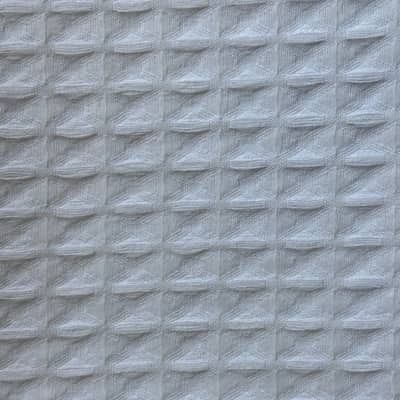
Textured Diamond Jacquard Fabric
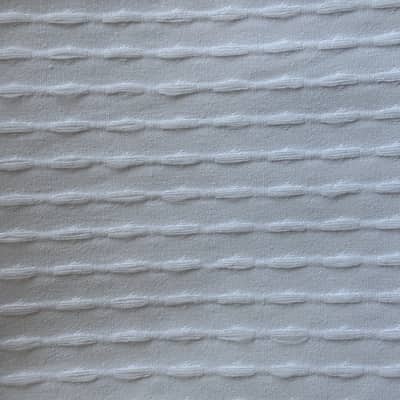
Vertical Dash Jacquard Fabric
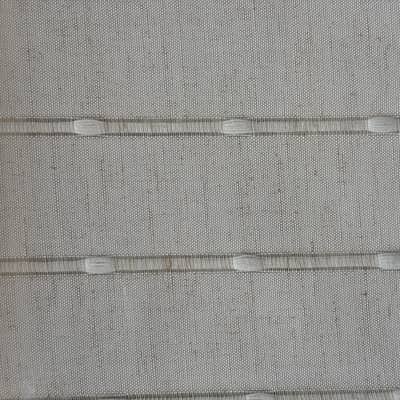
Horizontal-Slub Polyester-Linen Fabric
The Question That Arrives After the Sample, Not Before
A buyer shortlists a decorative fabric on the things a catalogue can show: a photograph, a weight, a composition, a price band. Density is almost never on that list. It is not printed on the swatch card, it does not appear in most enquiry threads, and it is not the number a mill volunteers when a quotation is requested. Yet it is the number that explains why two rolls at the same GSM can gather differently on the same rail, cut differently at the same panel width, and read differently under the same downlight.
The practical reason buyers skip it is that density feels like a mill's internal business. Warp and weft density in decorative fabrics is a construction fact, not a performance claim, and it sits one layer beneath the attributes buyers are used to comparing. That is exactly why it is worth pulling into the conversation: it is the layer where a specification either holds together or starts to drift between the sample and the second delivery.
What Our Own Search Rows Can and Cannot Show
Before treating density as a demand story, it is worth being precise about evidence. The first-party rows we can see describe searches that reached curtains.vip. They tell us which questions buyers bring to our catalogue. They do not establish market size, market share, growth, direction or any wider industry trend, and we do not read them that way.
The honest position is narrower. Density questions reach a fabric supplier because a buyer is trying to resolve a discrepancy they have already noticed — a sample that behaved one way and a bulk roll that behaved another, or two shortlisted rolls that looked equivalent and did not perform equivalently. The signal is a question type, not a volume. Where a metric is unavailable or zero, the useful move is to omit it rather than dress it up as demand, and to frame the rest as practical interpretation.
Density Is a Construction Fact, Not a Quality Grade
It helps to separate three numbers that buyers often collapse into one. Weight (GSM) describes mass per area. Composition describes what the yarn is made of. Density describes how many warp and weft threads occupy a given length of cloth. They interact, but none of them predicts the others reliably. A heavier cloth is not automatically denser, and a denser cloth is not automatically better for a given brief.
The commercial consequence is that a spec sheet carrying only GSM and composition can be internally consistent and still leave the two most useful questions unanswered. For a decorative fabric, density is what governs how tightly the surface closes, how much light passes between yarns, how the cloth responds when it is gathered, and how much the structure resists or accepts a print. Those are the behaviours a buyer is actually buying, and they are not visible in a weight figure.
Where the Number Shows Up in a Buyer's Own Programme
Three briefs meet density at different moments. A hospitality buyer meets it at the rail and at the replacement cycle, where a cloth that gathers unevenly or reads thin in a bright bathroom becomes a complaint rather than a specification issue. A retail buyer meets it at the shelf and in photography, where a surface that photographs flat or shows the ground through the face changes how the product is priced and positioned. A private-label programme manager meets it at the reorder, where the second run has to match the first in surface behaviour, not only in weight and colour.
In each case the buyer is not asking for a density figure as an end in itself. They are asking whether the roll will behave the way the approved sample behaved. That is a repeatability question, and density is one of the few construction facts that speaks to it directly.
Two Rolls That Illustrate the Trade-Off
The clearest way to see the point is to compare rolls that sit close together on the attributes buyers normally check. 27-DS001-B, a textured diamond jacquard at 185 GSM in 85% polyester and 15% cotton, and 27-DS001-E, a vertical dash jacquard at 195 GSM in 90% polyester and 10% cotton, are both heavyweight, both printable, and both carry a raised structure. A buyer comparing weight, composition and print status could reasonably file them together.
Textured Diamond Jacquard Fabric
Vertical Dash Jacquard Fabric
They are not interchangeable in a programme, because their structures read differently once the cloth is gathered or cut. A raised diamond and a vertical dash place their yarns along different axes, and that difference shows up in how the surface catches light, how the pattern aligns at a seam, and how much usable width survives the trim. Density is part of that story, and it is the part a buyer can ask about without needing to see the loom.
A second comparison sits at the lighter end. 27-008-8-A, a horizontal-slub polyester-linen at 140 GSM in 96% polyester and 4% linen, is printable and carries a directional surface. Against a heavier jacquard it will gather differently and present differently, and the reason is construction rather than weight alone. Neither roll is better; they answer different briefs, and the density conversation is what makes the difference legible before sampling.
What to Ask, and What the Answer Does Not Prove
A workable question is not 'what is your density' in the abstract. It is whether the supplier can state the warp and weft count for the exact SKU, confirm that the figure is controlled across production runs, and show the shortlisted roll gathered or cut in the position the finished product will occupy. That last part matters because a density figure on its own proves nothing about presentation. It is a construction fact that becomes useful only when it is tied to a viewing condition.
Uncertainty belongs in the note. A stated density does not guarantee a print outcome, a laundering result or a colourfastness performance, and it should not be asked to. It also does not travel between briefs: a density that suits a hotel drape may be wrong for a retail folded product or a printed table linen. The honest use of the number is as a comparison tool between shortlisted rolls, not as a certificate.
Where the programme involves a future print, colourway or logo, the printable status of the base belongs in the same conversation, because a roll that behaves correctly and cannot carry the next chapter will force a re-specification later. Shaoxing Haowen Textile Clothing Co., Ltd. (the company behind the curtains.vip team) develops curtain, shower-curtain and table-linen fabrics, including custom print development and finished shower curtain OEM/ODM, which means a density question can be worked across the three end uses against one construction conversation rather than three.
Two Things to Test Before the Next Shortlist
First, test whether the shortlisted rolls can be described in construction terms at all. If a supplier can state warp and weft density for the exact SKU and confirm it is controlled run to run, the roll is comparable on a fact rather than on a photograph. If the answer is vague, that is itself useful information about how the second delivery will be judged.
Second, test the presentation. Ask for the roll gathered on a rail, or folded and stacked, in the position the finished product will actually occupy, and retain a reference panel from that same roll. Density explains part of what the panel shows; the panel is what the next order gets compared against. Where a pilot run is needed to test a single property or retail door, the usual reference MOQ of 2,000 m per SKU applies, and orders below that are accepted with a slightly higher unit price. Neither test produces a forecast. Both produce something a buying desk can act on. The usual reference MOQ is 2,000 m per SKU; orders below 2,000 m are also accepted, with a slightly higher unit price.